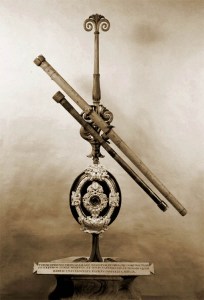
 “It is told there is a man in Padua who has created a most wondrous scientific instrument,” said the old traveler.
“It is so,” said his traveling companion matter-of-factly, “but it was not in Padua – it was Venice.”
“Hmmm, so it was,” replied the old traveler, remembering.
The mid-day sun beat down on the two travelers as they made their way along the dusty road. The winds had long since died down, leaving the air heavy and oppressive, giving no respite to the weary travelers.
“It is told the man has made the eye to see what is far distant as it were before him,” said the old traveler, looking to his companion for confirmation.
“I have heard the same,” came the reply.
“Is it to be believed?” asked the old traveler of the other.
His companion turned his eyes heavenward, and with a shrug of his shoulders, said, “He who told me swears by his mother’s grave that it is so.”
“Then I, too, will say it is so,” said the old traveler, a slight smile on the corners of his lips, his pupils deep pools of onyx.
Darkness shrouded one side of the giant mirror as it hurtled silently through space, its antennae spread like the wings of a giant albatross spanning twenty meters from tip to tip, capturing the prevailing solar winds on its lonely journey through space. The space mirror’s trajectory was intended to carry it past the planet’s sun-lit surface at an altitude of 20,000 kilometers, past the terminator, and beyond to the side of darkness and mystery. The mission of the Galileo Surveyor probe to Saturn: to place it into synchronous orbit over the polar regions, giving maximum view to the planet’s magnificent rings. The immense mirror’s x-ray enhanced radio-photometry was programmed to capture the phases of the planet’s rings, waxing and waning from a full-on panorama through the sliver of the on-edge view, twice in the span of a single orbit of 64 earth days. Mankind is drawn to the transformation of celestial bodies that like the moon goes through its phases, beginning in primordial darkness rising through ever increasing increments to the fullness of the lunar reflected lightness, and through the cycle of its decline into darkness once again. It heralds possibilities – the promise of birth and life, then death and once again rebirth – and touches an ancient longing some place deep within. The celestial eyes of the night wink, a flirtatious gesture from the bounds of the heavens, and man is always smitten.
The old traveler bent over his evening meal as his companion tended the fire. “You travel to Venice, my friend?” queried the old man.
“Yes, I am to visit with the master scientist himself,” answered the other.
“Oh?” responded the elder traveler, a curious twinkle in his eyes.
“Yes – I travel at the behest of the Archduke of the Hapsburg Court. This scientific instrument is of interest to his generals,” he concluded.
“Ah,” nodded the elder traveler, sadness in his eyes.
“You take exception to my mission,” queried the younger man, bewilderment in his voice.
“No, not to your mission,” said the elder traveler, a sad smile on his lips, “for it falls within the bounds of the business of those who make wars. It is just that our generals look to scientists for weapons for the waging of wars, and take little note of the price extracted by such venues.”
“Hmmm,” sighed the younger man aloud, “It is always thus, I am afraid.”
“Yes,” the elder nodded.
Signals beamed across millions of miles of space maintained the Galileo Surveyor spacecraft aligned along the axis of the signal beamed from mission control, keeping the mirror’s dish oriented toward the approaching planet. The onboard computer had long since locked the space traveler on two other solar system markers, the Sun and Neptune. Computer readouts at mission control confirmed that the mirror was anchored to three triangulation points, and the gigantic mirror swung full-face toward the approaching ringed-planet. Dr. Dareng Goodman, co-director of the Galileo Surveyor exploration of the sixth planet, watched as the computer image of the approaching planet took shape onscreen. A rousing cheer rose from the technicians and scientists in the mission control complex as the picture of light and dark cleared and there appeared an amazing sight.
“Work on the resolution of that image, Stefanie,” yelled Dr. Goodman across the banks of computers of mission control.
“I’m on it,” said Stefanie. Dr. Stefanie Purehardt is Galileo Surveyor co-director and project coordinator, whom he believes is the genius behind the project. The image onscreen was of a bright crescent, with a diagonal a mixture of light and shadow bisecting its face – the rings seen from on-edge.
“Stefanie, fix that orientation,” yelled Dr. Goodman.
“I’m on it,” replied Stefanie, and as she tapped a series of codes on the keyboard, the image onscreen rotated until the line of the rings appeared as a horizontal line across the planet’s partial face.
“Great,” yelled Dr. Goodman.
“Why’d you do that, Dr. Goodman?” asked a young man seated at console #47.
“It’s always a little distracting to view something not on either a north-south or east-west axis,” he answered. “Artistically, I much prefer the diagonal, something off-center,” he continued, “but for our purposes here, I prefer to keep things on a proper grid.”
“What does he mean, artistically?” asked the young man quietly of Stefanie.
“Dr. Goodman views what we’re looking at as a kind of artwork of the universe,” replied Stefanie to the young man over her shoulder. “He sometimes just likes to look at the images, not as a composite of digital impulses, but as an expression of some truth that is out there.”
“Oh.”
“The truth is that we are steady and unmoving at the center of the universe,” said the younger traveler. “This scientist speaks of a universe where the earth moves about the sun,” he added with a derisive chuckle.
“This man has spoken thus, I believe,” said the elder man. “As a scientist, he must be exceptional to have discovered an aid for seeing long distances – but, in matters of Holy Writ, he is clearly out of his depth,” said the younger.
“Perhaps,” replied the elder traveler.
“These words of his have caused quite a stir in the Holy City!” added the younger man growing more intense. “He should restrict his explorations to the tides and the workings of clocks.”
“Ah, he should be so wise,” responded the elder traveler thoughtfully. “It is reported the Cardinal Tomaso Nellusone called upon him at his home in Padua a month ago asking that he recant his publicly stated belief,” said the elder man softly. “He is stubborn and bull-headed, this man – he refused.”
“He is that, and foolhardy!” said the younger man.
“Yes,” nodded the elder. “Cardinal Jamasini Bertoni has called a tribunal at the Medici Court for the end of this month,” said the elder traveler.
“The Pontiff Jassui Gaeyuordini and the whole of the Holy City will watch these proceedings with much interest,” said the younger traveler.
“Indeed they will,” responded the elder, “As will I.”
Preliminary review of images received from the Galileo Surveyor probe produced images with high definition of the rings of the planet, promising significant materials for study and analysis in the coming months. Dr. Purehardt credited the quality of the images to the dedicated work of the technical crew, the state-of-the-art hardware she had been able to amass for the endeavor, and pure and simple luck. She kept a small figurine of a leprechaun seated on a tree stump tipping his hat on the top of her console as homage to this latter element of the project – one doesn’t take anything for granted with NASA projects. Dr. Purehardt watched the image onscreen, and gave quick and concise instructions to her crew of technicians to improve its clarity. The crew responded as quickly, and watched in wonder at the unfolding events millions of miles distant. Dr. Goodman looked over to Dr. Purehardt and winked his approval. Dr. Purehardt smiled in return, and turned to the monitor screen.
The day was drawing to a close as the two travelers prepared themselves for the evening’s respite. The sun set across the wide valley, and seemed momentarily to pause at the lip of the mountains to the west before slipping beyond the darkened ridge. The two men sat and watched in silence as twilight drew around them.
“I suppose this scientist will plead innocence,” said the younger traveler.
“I do not know,” replied the elder – “He is very stubborn, and I know not whether he will consider the implications of his position.”
“You do not believe he is correct in stating that the sun is the center of our universe?” asked the young man, a sly smile crossing his lips.
“Oh, I believe he is stating his beliefs on the matter,” responded the elder traveler quietly, avoiding answering the young man directly.
“He makes a persuasive argument for his views,” he added. The elder traveler sighed, and looked to the distant heavens – “Do you see that light in the heavens just above the hills to the north? Beyond those hills lies the Holy City – that light, my friend, portends something momentous in our times.”
The young man followed the elder’s pointing finger to the tiny light in the sky. “How do you know this?” queried the young man.
“It is in the stars, my young friend – it is in the stars,” indicated the elder, his voice but a whisper. And just for a moment the young man thought he felt the earth move.


 Journeys of a Bent Mind
Your puns, even tho a bent mind (maybe that helps) are a nice twist and challenge to even the unbent mind, if mine is such.
LikeLike