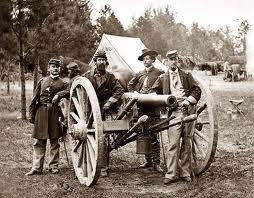
 Lance Corporal Presseny Key sat huddled under his rain slicker, and looked through the gathering darkness across the deadly expanse of no-man’s land. Heavy storms had obscured the mountain for most of the day, drenching everything in a downpour of the magnitude of Noah’s plight. Now, aside from the steady pounding of the heavy rains, an eerie silence hung over the battlefield, casting an even darker pall over the surrounding woods and fields. It was the worst of times, and for Lance Corporal Key, time stood still. He knew, though, that Lt. Ramis Beauregard, Ram Beau to the troops, would soon be giving the order to advance up the mountain – then, time would run backwards.
Lance Corporal Key was numb with terror, and felt he was going to be sick, and wanted to run in the opposite direction and hide from all this horror. He pulled his rain slicker tighter around his shoulders and his upper torso in an effort to keep his powder horn under the protection of his now soaked overcoat, trying to keep the moisture from dampening his powder. It was a losing battle – just like this one for bragging rights to the top of the mountain. That’s what it seemed, though his superiors had said it was probably more than that. Probably!
Lance Corporal Key’s regiment had laid siege to the lower flanks of this devil mountain for the better part of a week, and their losses were heavy, and with all that they had made pitifully little progress in capturing the mountain top. Many of his regiment were casualties in a battle that neither he nor they understood, and one which seemed surely destined for failure. He had himself sustained a superficial wound on his upper leg in an early morning assault two days ago, when over 9,000 casualties were sustained that day alone in a combined total for both sides. While his injury wasn’t painful or in any way incapacitating, he knew in time it could mean the loss of his leg, or worse, the drawing of his last breath. That prospect loomed in the back of his mind, all the more because of the penetrating cold.
The battle for Byte Mountain proper began six days ago, and both sides were paying an extremely high toll. Lt. Ram Beau was thrust into command of the 34th Massachusetts Regiment on the first day of battle when Capt. N. Sufficient Memory was cut down by a withering fusillade from above.
The Confederates were well entrenched among the rocky crags on the upper ridges, and could just as well have thrown rocks down upon the Union soldiers with equal effect. It would have helped the Confederates with a savings in their limited and diminishing supplies of gunpowder. Lance Corporal Key was able only to get several shots off against Confederate sharpshooters before being pinned down himself. Others around him had had the same fate, though some were much worse for their efforts, and as a result would not see the light of the next day.
Lt. Ram Beau tried to muster his men for yet another charge, though against horrific odds, not least of which was the terrain itself, and Lance Corporal Key thought him at once courageous and insane. But his powder was wet, and his hands frozen by the chilling rains, and loading his rifle in a prone position with fingers not working very well, wasn’t working. His shoes were caked with icy mud, his clothes soaked, and with the penetrating cold he could feel the pain in his leg beginning to spread in ways that troubled him. He prayed for the rains to stop, and the sunshine and warmth to return. He prayed for the end of battle.
At Union headquarters near the Four Corners just north of the mountain, General Protection Fault gathered his regimental commanders around a large though incomplete map of Byte Mountain and the surrounding area. Reconnaissance reports did little to fill in critical and strategic areas of the map, let alone Confederate troop strengths on the crest and sides of the mountain fortress, and General Fault was irritated with such gaps in the knowledge at his command. His nemesis and old West Point war college colleague, General Jaylord Windows, had captured and secured Byte Mountain through a brilliant lightning strike in the middle of the night, outflanking General Fault in a most daring stratagem.
General Windows selected as his field headquarters the very peak of the mountain for its commanding and imposing vista of the surrounding region. The southern flank of the mountain, comprising the expanse of the farms of Jeremy Doss and Edward M. Hertz, was crisscrossed by a network of roads, with one in particular, Alta Oak Lane, leading part way up the mountain itself. Due to the rough and rocky terrain, this sector was well under the control of just two Confederate regiments, and would give protected passage to the southern army should retreat ever be a necessity. General Windows looked down upon superior numbers of Union forces with not a little satisfaction.
Lt. Colonel Thomas N. Haardrive, commanding the embattled 67th Virginia Rifle Brigade along the lower perimeter, held the first line of defense against Fault’s Army of The Potomac. Ruthless in reputation, Haardrive was devilishly cruel with his own troops. Nicknamed “Crash Haardrive” by men serving under him, he drove his men with unrelenting and unmerciful intensity, and numerous were those who slipped off into the night, deserting the cause that once brought them to stand for their country within a country. Disillusioned, cold and hungry, and no longer willing to accept the abuse of their superiors, hundreds left in this way, to honor’s great loss.
Along the upper stony ridges, just below Chancellor’s Break, Major General James B. Virhus held the second line of defense commanding the combined 43rd Regiment of South Carolina and the 17th of Tennessee. Virhus was a third generation immigrant from Europe, following in the footsteps of his father and great uncle, both former officers in the Prussian army. Virhus had graduated second in his class at West Point, a year following Generals Fault and Windows. He was intelligent and quick-witted, gifted in managing minute details in assessing the strength of the enemy, and masterful in strategic maneuvers under the heat of battle. His was the plan followed by General Windows in the taking of Byte Mountain ten days prior.
But Major General Virhus was by nature a loner, prone to bouts of crippling depression that affected his judgment at times. His acerbic and biting tongue played havoc and wore heavily on his underlings, and men of the line carefully avoided all direct encounters with the man. Corporal Mack Entossh of the 43rd South Carolina Regiment, knew well his commanding officer’s vitriol. Being originally from Boston, and unfairly maligned as a Northerner at heart, he was the undeserved recipient of much of Virhus’ angry tirades since his enlistment. It was he, who in the heat of the fierce battle at C. Daniel Rhom’s farm house, in an instance of unbridled rage engendered by the callous and ill-tempered General’s abuse, sighted along his mountain rifle with deadly calm at a spot just behind Virhus’ left ear, and pulled the trigger. None were the wiser for how this loss came about, for it came in the height of confusion during the pitched battle around the farmhouse.
A Northern sharpshooter was credited with downing the Major General. Corporal Entossh, for his part, the next night slipped silently into the darkness and was gone, never to be heard of again.
The death of Major General Virhus represented a serious loss for General Windows and the Armies of the Confederacy. Challenged by the overwhelming numbers of the Northern Armies from the initial firing upon Fort Sumter, as well as by their superior armaments and firepower throughout the war, General Windows relied heavily upon skill and cunning in waging the South’s argument against the Union. Major General Virhus was especially deft with the slight of mind that confounded the likes of General Protection Fault, and his loss was not insubstantial.
General Windows selected a young officer from amongst his regimental commanders, one who had risen through the ranks, to succeed the deceased Virhus to carry forth the war for secession. Major General Random A. Memory, uncle to Captain N. Sufficient Memory, himself a brilliant scholar of ancient battles while of wit but half that of his adversaries, because of his calm dash was he granted a field promotion on the nomination of his Commanding General.
At midnight on Sunday the sixteenth of October, a night of the new moon, under the remnant clouds and scattered drizzles of a waning thunder storm, General Protection Fault sent Lt. Ram Beau with four regiments of his finest sharpshooters and two regiments of cavalry in a pincer movement around Byte Mountain to secure its southern access.
By five o’clock that morning, as the eastern skies slipped from the dark of night to the whisper of predawn light, Lt. Ram Beau had his men in place 300 yards from the first line of Confederate defenses. Corporal Icahn Mouus, and Lance Corporal Key, sent as point guards to scout the Confederate sentries posted along the roads leading to the southern reaches of Byte Mountain, returned with word that sentries were posted in but a few locations, and the stretch of Alta Oak Lane leading to the mountain was essentially unguarded. Lt. Ram Beau stood in the dark next to a small outcropping of stone near Alta Oak Lane, and struck a match, shielding it from the elements. It flared momentarily and was swiftly extinguished, but its brief flame gave the agreed-upon signal to engage the enemy.
With the pounding of the hooves of the cavalry sounding as thunder unleashed, joined by the banshee wail of Corporal Mouus, a Virginian who elected to serve the Union opposite his brother, the Union forces struck quickly and decisively, sewing terror in the enemy rudely aroused from slumber. Lt. Ram Beau led the charge of the two regiments of cavalry in a direct thrust up Alta Oak Lane, breaching the first line of sleeping defenders, and driving toward the redoubts dug into the upper reaches of Byte Mountain.
Captain U.P. Graade led the 34th and 39th Regiments of Massachusetts regulars in an assault across Hertz’s farm against the right flank of the Confederate defensive line, as Lt. Keye Bord led the charge of the two Pennsylvania Light Rifle Brigades, the 7th and the 28th, against the Confederate left flank. The din and fury of the assault washed over the sleeping Confederate soldiers, awakening them to the sudden shock that their positions had been overrun. There was madness in the scramble for weapons in the dark, as the frightened men attempted to rally under the wave of soldiers in blue. Dense smoke spewed out of a hundred muskets all around, and cries and screams split the air.
Lt. Bord’s 28th Brigade struck the Confederates on their left flank with sudden fury, cutting down clearly a quarter of the sleepy defenders in their initial volley. As the Rebel defenders under Capt. Robert E. Mail rallied to return fire, the 7th Brigade under Lt. Bord let loose a withering volley into the confused midst, as the 28th quickly reloaded. Men in grey and homespun dropped in their tracks, killed outright or severely wounded. The remaining men and boys tried in vain to return fire, but soon their numbers and will faded, and they abandoned their weapons and surrendered.
Meanwhile, Capt. Graade’s two regiments of Massachusetts regulars slammed into the defensive line on their left. The Confederate right flank had heard the sounds of Lt. Ram Beau’s cavalry charge as it carried the center of the defensive line, as well as the clatter of muskets coming from their own left flank. In the first few minutes following the initial clash, Lt. P.C. Monitor led the defending Southerners in a wild and courageous effort to repel Graade’s men, much to the latter’s surprise, but Lt. Monitor’s defense was too little and too late.
The sustained firing by the 34th and 39th Massachusetts regulars, coupled with their superior arms, quickly overwhelmed the troops of Southern defenders, and brought them to their knees. Acrid smoke obscured much of the battlefield, as the fighting waned and the firing ceased. Then all was silence, but for the cries and whimpers of the dying, a sound wrenching on the ear.
The first rays of the rising sun touched the summit of Byte Mountain before it reached Hertz’s farm at its foot. General Windows was in receipt of communications from his commanders defending the southern perimeters of the mountain that the battle of Alta Oak Lane had been lost, and southern access to the mountain was now under the control of Union troops. Byte Mountain was completely surrounded by the enemy, and all avenues of escape denied.
General Windows considered circumstances facing his command, and solemnly called his regimental staff together. Byte Mountain, while not a major pressing point in the South’s argument against the Union, was nevertheless a matter of pride in the scale of battles won and lost. General Windows addressed his commanders in subdued grave tones, expressing his gratitude and pride, and that of the South, for their courageous efforts in their sacred cause.
The loss of Byte Mountain would go down in history as an embarrassment for Robert E. Lee and the South, but General Windows wanted to insure that his staff knew it was of his doing, not due to any lack on their part. By mid-morning, through an emissary under a flag of truce, with a mind toward minimizing the further loss of men under his command, General Jaylord Windows petitioned General Protection Fault of the Army of The Potomac “for the honorable surrender of the troops under my command, the Armies of Virginia, South Carolina, and Tennessee…”
In the lazy early afternoon of October 17th, storm clouds now dissipated, the sun warming the flanks of Byte Mountain, Lance Corporal Key sat on the lip of the ridge overlooking the Shenandoah Valley. The smoke of battle was now cleared, aided by a gentle wind blowing from the south, the sounds of guns stilled, and he was feeling warmth return to his leg once again. He drew a wrinkled slip of paper from his blouse pocket, and taking the stub of a pencil, dabbed it on the end of his tongue and set to writing a letter to his father in Gettysburg…


 Journeys of a Bent Mind
😉
LikeLike
My battles with computer elements are not as epic as “The Battle of Byte Mountain” but I can certainly relate. Nice metaphoric rendition!
LikeLike