
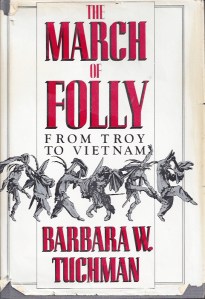
 Barbara W. Tuchman; Alfred A. Knopf, New York; 1984; pg. 234.
Barbara W. Tuchman in her volume, “The March of Folly,” describes in painful detail the processes that individuals and groups pursue in spite of commanding evidence that the path chosen is foolishness to the extreme, the existence of viable alternatives clearly known by the participants, and how ample cautionary indicators fail to prevent the ongoing pursuit of such goals. She treats the classic folly of Troy and the Trojan horse, the Renaissance Popes, who nearly destroyed the Roman Catholic Church, the actions of the British against a colonial America that drove the colonists into full rebellion, and the height of folly in our time, until now, the Vietnam war…
Here are the initial paragraphs of her treatment of our involvement in and ultimate misery with what we know as the Vietnam war:
“Ignorance was not a factor in the American endeavor in Vietnam pursued through five successive presidencies, although it was to become an excuse. Ignorance of country and culture there may have been, but not ignorance of the contra-indications, even the barriers, to achieving the objectives of American policy. All the conditions and reasons precluding a successful outcome were recognized or foreseen at one time or another during the thirty years of our involvement. American intervention was not a progress sucked step by step into an unsuspected quagmire. At no time were policy-makers unaware of the hazards, obstacles and negative developments. American intelligence was adequate, informed observation flowed steadily from the field to the capital, special investigative missions were repeatedly sent out, independent reportage to balance professional optimism — when that prevailed — was never lacking. The folly consisted not in pursuit of a goal in ignorance of the obstacles but in persistence in the pursuit despite accumulating evidence that the goal was unattainable, and the effect disproportionate to the American interest and eventually damaging to American society, reputation and disposable power in the world. The question raised is why did the policy-makers close their minds to the evidence and its implications? This is the classic symptom of folly: refusal to draw conclusions from the evidence, addiction to the counter-productive. The ‘why’ of this refusal and this addiction may disclose itself in the course of retracing the tale of American policy-making in Vietnam…”


 Journeys of a Bent Mind