
 Cheri slipped her hand into her Grandfather’s as they approached the antique store on the corner of Columbus Avenue and Fifth. The sun was partially hidden, and there was a slight breeze blowing down the canyons of tall buildings. On any other day, Cheri would be craning her neck to see the tops of the buildings against the sky, they were always so impressive, but today she had something more important on her mind.
She had risen at the crack of dawn, and had bathed and dressed and was eating toast with jelly by the time Grandfather was even up and down for breakfast. She could hardly eat anything, though, she was so excited with the prospects of today’s trip into the city.
Grandfather had found the perfect gift for Cheri’s seventh birthday, one he thought her mom and dad would have loved to give her. Cheri’s parents had died in a plane crash two years ago, leaving only Grandfather and Grandmother as family to care for her. Of course, there was no question but that she would come to live with them.
At first the times were hard, because the deaths were so sudden and tragic, and Cheri couldn’t understand any of the explanations Grandfather and Grandmother gave for what happened, and more importantly, why. They had a hard time understanding the whys of it themselves, and they hurt for Cheri whom they knew hurt deep down inside.
Grandfather had been looking for this special something for Cheri ever since the double funeral. He didn’t know exactly what it would be, but he had this sense that it would be something of his son and daughter-in-law, and he would know it when he saw it. That was almost two years ago.
Then, by chance he had business in New York, and after dinner one evening went for a stroll with several of his colleagues from the university. As they walked down Fifth Avenue and approached Columbus, a taxi came careening around the corner and jumped the curb, smashing into the light pole near the corner. There was a cacophony of noises as tires squealed and metal smashed against glass.
Then, almost in slow motion the lamppost went down, smashing into the window of an antique store there on the corner, sending glass in every direction. The men ran up to the cab, and opened the door and helped the driver out. He had a cut on his forehead, which seemed to be bleeding more profusely than the superficial cut warranted.
The driver sat down on the curb, holding a handkerchief to his forehead. He swore, and looked with disgust at his crumpled business and the smashed storefront window.
As they waited for the ambulance and paramedics to arrive, Grandfather looked in the window of the antique store. There amid the smashed shards of glass and broken pieces of metal, was a locked showcase of antique music boxes, one of which was a lavender piece with fine hand-carved figures on the sides. Grandfather couldn’t make out the figures in the dark, but was drawn to the lovely creation, and determined he would return in the morning to see it in the light.
Grandfather was waiting at the store before it opened the next day. The storefront windows were boarded up with plywood sheets, the handiwork of craftsmen in the middle of the night following the accident. He greeted the owner as she approached and unlocked the door. She looked harried, Grandfather thought, most likely having been up much of the night handling the aftermath of the accident.
After giving the owner some time to settle into her shop, he asked if he could see the lavender music box in the locked showcase. The owner’s eyes lit up, and she smiled, and asked why Grandfather was interested in that particular music box. Grandfather said he didn’t know, really, but during the time they were waiting with the cab driver after the accident, he had noticed it in the showcase, and it had this strange attraction about it.
The owner nodded her head, and said she understood, and proceeded to unlock the case and took the piece out for Grandfather to examine. It was squarish – 10 inches long, 6 inches deep, and 5 inches tall. It was very heavy. It struck Grandfather, though, that the color wasn’t lavender as he’d thought in the dim light of the previous night; it was steel-grey. That was the color of his daughter-in-law’s eyes – and, of Cheri’s.
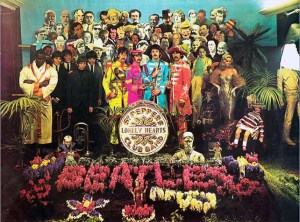
Grandfather lifted the lid of the music box, which swung open on silent hinges. Instantly, the room was filled with the strains of a familiar tune, caught in mid-melody. Grandfather thought briefly, and recognized the music as that of the Beatles – “Sgt. Pepper’s Lonely-Hearts Club Band.” “That’s unusual for an antique music box,” said Grandfather looking skeptically into the eyes of the shop owner.
Her eyes sparkled, and she smiled again: “Yes, most unusual,” she said, “and there’s quite a story behind it. This is truly an antique. It is from the collection of the great-granddaughter of a Russian nobleman who came to this county at the turn of the century. She was grown, and then some, when she fell in love with the Beatles on their arrival from Liverpool. And as the story goes, had a new music mechanism put in to replace the original one.”
“Do you know why the Beatles, and why this piece?” asked Grandfather. “It is said she was left by a suitor, and in her anguish chose to be in seclusion after that.”
The store owner looked thoughtful. “This one piece apparently touched her,” said the woman. “It is a lively piece,” said Grandfather. “It is,” smiled the woman.
Grandfather paid the woman for the music box, and asked her to hold it for him until his granddaughter’s birthday, which would be in two weeks. He would return with his granddaughter on that date and claim it. It was to be a secret. The storeowner placed the music box back in the glass showcase, and placed a tiny sign on it that read “Sold.” Grandfather left, whistling “Sgt. Pepper.”
The next morning, Grandfather went to the public library on 54th Avenue. He asked the librarian where he might find information about Russian nobles and wealthy Russian families who had immigrated to this country at the turn of the century. He was directed to the Eastern Division, European Section, of the Journal Room. Grandfather spent the next four hours poring over file cards, going to various stacks, and back again.
Much of the materials were in Russian, but finally, he found an article in English, titled, “Countrymen in Exile,” in an old 1922 journal, Motherland. The paper was that of an early Russian association to aid and support recent immigrants to the New World.
The editor, one Illya Turganyev, himself a former military advisor to the Czar, wrote about the families of noble heritage living in the New York area, and of their life and times.
One nobleman, Petrov Chernenko, was betrothed to the daughter of the Russian Ambassador to the United States, the beautiful Tatyana Byanovich. The article ended by noting that Petrov Chernenko had been ordered to return to the Motherland to accept a commission in the new Russian army. On the night of his anticipated departure, he disappeared into the night, leaving nary a trace.
Grandfather was thoughtful as he returned the journal to the librarian. He asked if she knew whether the Russian Consulate in the city had a library or a research division; she said she didn’t know, but would make a call for him, and disappeared into the inner sanctum of libraries, the back room. She hadn’t been gone long, when she returned smiling. “They don’t have a library or research division, but they suggested you contact the Russian Home Society over on 117th Avenue, off DeLong Street near the harbor.” Grandfather thanked the librarian, and walked out of the library into a drizzling rain.
The Russian Home Society was a throwback to the early days of immigration to the United States. All ethnic minorities banded together for self-help and mutual support in the strange new land. They did it because of language, but also for cultural and religious reasons, and importantly around the food.
The more outgoing and aggressive individuals, often those most knowledgeable about faring in a new culture, passed on information and tips about surviving in a place where people didn’t understand your language, or appreciate your manner of dress. And with that support, with those invaluable tips, newcomers made the transition to the New World, and began to make lives for themselves.
It happened in New York at the turn of the century; it happened everywhere that newcomers were received by their countrymen; it happens today.
The woman at the receptionist’s desk greeted him cordially in English, but with a heavy Russian accent, and asked how she might be of help. Grandfather explained his purchase of the music box, and of learning the story of the owner, the daughter of a noble family and the Russian Ambassador to the United States. He asked if there were any records about the woman, about her once suitor, and what happened to either or both.
The woman looked at Grandfather, and smiled – she said she had heard of this couple in another lifetime, and remembered it as so romantic. Grandfather asked what she recalled of the story, and she replied that as a little girl she had heard the story from her mother.
The nobleman was from a very wealthy family, and was very handsome. He was betrothed to Tatyana Byanovich, and they were both very happy. Then rumors of unrest were heard from the homeland, and Petrov Chernenko was ordered to return home to Russia. He was heartbroken, and felt ambivalent about any allegiance to the Czar.
“My mother told the story that he said goodbye to his love on the eve of his return home, and said he would return one day to claim her hand. He said he loved her more than anything in the world, and their love would keep him until they were reunited. And then he left.
But the story is told that he did not return to Russia, and no one knows where he went. Tatyana received letters from him, but they were always removed from their envelopes and hand-delivered by friends who professed not to know his whereabouts. In the lengthy letters, Petrov told of his ardent love for Tatyana, and once contained some photographs. He was indeed very handsome. Tatyana looked forward to each letter.
Gradually, the letters came less often, and then they stopped. Tatyana was heartbroken, and she saw her friends less and less. One day, she was gone – she had packed a few of her things, and had left like a ghost in the middle of the night, without a word to anyone. It was learned years later that she had retreated to a secluded country house in upstate New York. She died alone in August of 1990 at the age of 89.”
The receptionist looked at Grandfather and smiled, but her eyes conveyed a deep sadness. “What of Petrov?” asked Grandfather. The woman shook her head, and said, “He is lost in the mist of the past, I am afraid. I know of nothing that sheds light on his end, and there is nothing further in any of our records about him.”
“Do you know the Beatles?” asked Grandfather of the woman. Startled at the sudden shift in subject matter, the woman laughed, and said, “Of course, my daughters were teenagers once!”
“Why would Tatyana, the daughter of a Russian nobleman, daughter to the Ambassador, like the Beatles?” asked Grandfather.
The woman laughed again, and said, “I don’t know, but perhaps it was the uniforms; women love men in uniforms – and they were so, so…Russian!” Grandfather laughed, too, and said he supposed so. He thanked the woman, and walked out into a heavy rain.
Cheri grasped Grandfather’s hand tightly as they crossed the street at the light. Her eyes caught the glint of sun reflecting off the windows of the tall buildings along Columbus Avenue, and her face beamed as they approached the antique store.
Grandfather stopped at the window, now repaired, and looked inside. The store was empty, and the woman nowhere to be seen. He grasped the doorknob and turned it, and the door swung open, and they entered. The little bell on the doorjamb tinkled as the door swung open, announcing their presence.
The curtains in the doorway to the back of the shop parted and an elegant woman with grey hair entered the room. Her eyes lit up when she saw Grandfather, and she bent down and greeted Cheri warmly.
“What brings you out to my shop today?” asked the woman with a twinkle in her eyes. She was fairly beaming. Cheri said they were here for a special gift for her birthday. “Oh?” said the woman, with a wink of her eye to Grandfather.
“What do you have that’s special for a seven-year old girl?” asked Grandfather of the woman, playing his part. “Oh, I think I have just the thing for a special someone,” she said, turning to the locked showcase.
She unlocked the door of the case, and brought out a magnificent steel-grey music box, and set it down on the glass countertop. Cheri’s eyes widened, and her mouth opened, and she took in a deep breath. She touched its side, her fingers feeling the satin-smooth finish. She eyed the carved figures along its sides. She lifted the lid, and immediately recognized the music.
Her brow furrowed momentarily, but she was soon lost in the sweep of the music, and her frown gave way to a grand smile. She lifted the box off the counter, and cradled it against her breast, and closed her eyes.
She turned to Grandfather and with one arm holding the music box, grabbed him with the other and hugged him hard: “Thank you, Daddy,” she said. Then, she corrected herself, “I mean, thank you Grandfather…” She closed the lid of the music box, and the shop was as still as midnight.
She turned it over, and inspected the winding key. Her eye caught the edge of a tiny door in the bottom, virtually hidden because of the fine workmanship. Inside Cheri found a piece of old yellowed newsprint. It was a clipping from a newspaper, an obituary for a Tatyana Byanovich – she died on August 13, 1990.
“That’s my birthday,” said Cheri, her wide eyes, locking on Grandfather’s…


 Journeys of a Bent Mind