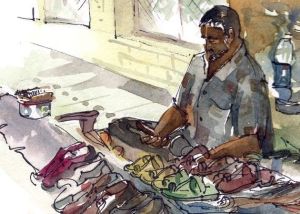
 In a land east of the sun, west of the moon, in a time very long ago, there lived a lonely cobbler and his faithful donkey. He loved to sit in the window of his shop and daydream memories from his childhood of the sunshine and flowers on the hillsides that followed the spring showers, and of the bubbling brooks as they wound their way to the sea. The animals of the land lived in harmony with the villagers who walked tall through the grasses of the meadows. The south winds carried the moist air from across the ocean, and there was always refreshing water for plants and animals and villagers alike. Those were the happy days when the villagers danced – before the darkness.
It happened not all at once, and no one sensed the changes that gradually took place throughout the land. At first the rain clouds came less often, and the heat of the sun grew by little increments. The grasses of spring were later in coming, and the brightness of their hues seemed to last only a brief span before lacing the hillsides in amber and pastel browns. The winters were harsher than in the collective memories of the people; the winds chilling to the bone and colder than grandfathers remembered. The rivers slowly began to die, some drying to dusty wind-blown scars across the landscape.
Farmers struggled to bring in their harvests, but because the rains did not come and the hot winds blew, the land became parched and barren, and the marketplaces went bare. The peoples’ suffering deepened and they were sorely in want. The cobbler struggled to make ends meet, but when the people had naught for food, they had less for shoes or their repair, so the lean years for the whole village were leaner still for this good man and his faithful donkey. And it happened – that the villagers no longer danced.
One day there came to the village a great man who brought a message of freedom and plenty to the people. “Who is this man?” the people asked, but no one knew. “From where does he come?” someone asked, but again no one knew. “How will this man bring freedom and plenty to us?” another asked incredulously, but still no one knew.
The great man spoke and when he spoke milk and honey and the velvet petals of roses poured from his mouth; when he spoke the silver tongues of angels spoke, and the people were entranced. The great man touched a deep ache within the people of the village, a desire to dance once again – so they believed.
The great man called the cobbler to him one day and said he wanted him to make beautiful shoes for all the people so they could dance the dance of life once again and be free. The cobbler was proud and honored to be asked to do this great work, and so he said yes. Inwardly, however, he doubted and could not see how he could make all those shoes, for he had no new hides.
The great man said there would be hides if he believed and truly desired to make the shoes. Not wanting to disbelieve, the cobbler began. But the cobbler remembered the darkness of the elder days and did not believe there would ever be enough new hides. He cut the patterns for his shoes a measure smaller than usual, and sewed them very tight. The people of the village bought their new shoes, and tried them on and danced in the streets.
At first they were delighted because it felt so good to dance again. They felt free, and so they danced into the night. They didn’t mind the slight pinch in their instep when they leaped. They danced and danced, but ever beneath their enjoyment there was a growing awareness of pain. They rubbed their feet, and returned to their dancing. Their feet grew tired with pain, but the villagers soaked them and still they danced, the words of freedom resounding like a bell in their ears. All the while the pain grew, but they did not stop because they longed to believe.
One day an elderly man came to the cobbler and said that his feet hurt from all the dancing, and he thought it might be that the shoes were too tight. The cobbler said, “Oh no! The shoes are perfect. I am a master cobbler and have made you a fine pair! You must be landing on your feet incorrectly.” Befuddled, the elderly man left and went back to his dancing.
The next day a young woman came to the cobbler and complained that her feet hurt because her shoes were pinching her feet. “Oh no!” said the cobbler. “The shoes are perfect. You are leaping from the wrong side of your feet. That is what is wrong!” Confused, the woman, too, left and went back to her dancing.
Soon many more came to the cobbler and complained that their feet hurt and asked that he fix their shoes. Each left a little puzzled, and with the admonition that they were doing some-thing wrong; they should study more the techniques of dance, because the shoes were perfect.
The great man heard the grumbling of the people but continued to speak his beautiful words of freedom, and the people tried still to dance because they wanted to believe. But the people of the village weren’t happy any more; they didn’t have that reflection in their eyes of the connection with their souls; and they weren’t as full of their dancing as they once were.
One day several villagers met while shopping at the market, and first one, then another talked about their shoes and the pain. Yes, for the first time they talked about the pain they felt, and all then knew it was because of their shoes. Everyone knew too that the cobbler did not believe so, and alas they knew they couldn’t tell him the shoes pinched because he became so angry. So, when the people danced, they didn’t speak about the pain or the shoes. The cobbler watched and loved the dancing, but did not know or understand.
One day the great man happened upon a group of villagers in the square and overheard them talking about the good old days when the soul danced and it was so beautiful. The great man said the dancing of the villagers had surpassed the dancing of the elder days because they had touched their very centers.
The people told the great man he was mistaken; that they danced because they longed for the old days when they were free and happy, but their dancing now was pained and labored, all because of the ill-fitting shoes of the village cobbler. The shoes were tight and pinched, and there was always the pain when they leaped.
The great man was surprised at their sentiment, but gathering himself he thanked the people for their honesty; he thanked them for their dedication in continuing to dance for their love of leaping in spite of their pain; and he thanked them for their love of freedom and their homage to the muse of dance in spite of their suffering.
The great man said he would see that the cobbler received new hides so he could cut each person a new pair of shoes, and the whole village would once again dance in love and free from pain. And the great man went away to his castle on the hill.
A week passed and the people of the village saw nothing of the new hides for the new shoes, and the cobbler seemed as cross and crotchety as ever. A month passed, and the people saw nothing of new hides, but the great man sent a message that the people were wondrous for their belief and for their dedication.
A fortnight and still no new hides. The great man sent many messages telling of the joy of the dance, of the fruits of freedom, and how the village benefited from the peoples’ ever striving. But the new hides never arrived, and the thought of new shoes faded as though a dream.
The people of the village no longer danced, and never spoke of their shoes. They longed for the days of spirit and fun and leaping; they longed for those days of sunlight and beaming faces and happy hands and the pull of the earth as they leaped into the air. But it was now only a shadow amidst the nightmare of hurting feet. So, they dreamed no longer.
One day the great man came down from his castle on the hill to the village square to speak to the people of renewed freedom. There was a great stillness there, and there was no one to be seen anywhere. The great man looked high and low, in the back streets and the near alleys, along the river and up the main street in all the shops. He called out to the baker and the printer and the milkmaid, but there was no answer.
The village was deserted; the people had gone. Near the center of the square next to the west-facing wall, the great man found the cobbler huddled next to a large pile of shoes. Pinned to the wall above the shoes was a parchment scroll with the word “Sesame” printed in beautiful script. And beneath it, “Free to leap.”


 Journeys of a Bent Mind