Racism is a funny thing sometimes. Oh, don’t get me wrong, I don’t mean funny “ha-ha!” or to diminish the evil it represents, but funny on occasion as in peculiar and unintentional. Maybe that’s still too cavalier and I should think in more serious tones. But bear with me here, let me explain what I’m getting at underneath this comment as a lead-in to the point of the story I’m sharing
There are various colorations of racism when you think about it. There is that hateful menacing variant that belittles and dehumanizes an entire group of people, its worst unfolding being the mass murder of six million Jews, its only slightly less despicable version burning a cross on someone’s lawn. These are acts of evil, pure and simple, and I’m not referring to these.
Then there is the rendition that has much of the fervor and hatred of the first, but it stops short of killing or physically harming people but relegates them to the back of the bus or restricts housing. This is what we think of as institutional racism. Again, nothing to laugh about.
But there is a third kind that has its roots in these two forms that seeps into one’s psyche in spite perhaps of the best of intentions. This is the basically good person raised by well-meaning parents, of a religious persuasion perhaps, who innocently comments “all Asians look alike!” I previously shared about an OLLI member who thought “your people were remarkable in spite of being detained in concentration camps during WWII because they didn’t cause any trouble!” I don’t fault her as a hateful person, although her comment would cause hurt with some individuals of a less charitable mind.
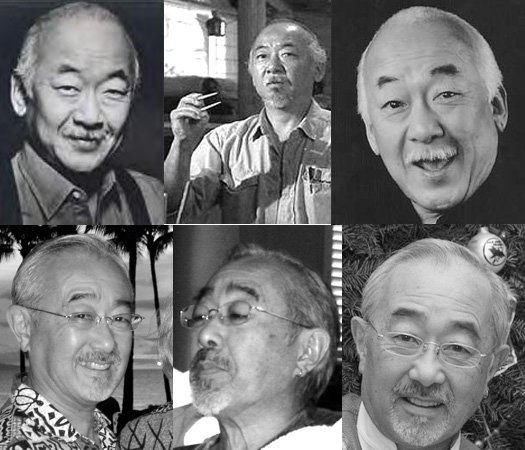
I have had a personal experience that I think of as this racist thinking of the third kind, and I’ve chuckled about it each time it has happened. I’ve abided it through much of my life after a spawning event that was totally unexpected. This started shortly after the movie The Karate Kid opened in 1984. It soon became a run-away sensation, and its characters became instantly recognized celebrities.
One fall out of all this happened to me, and I have to believe it likely happened to any number of other Japanese American men as well. Typically, the way it unfolded was I was accosted in public by people who approached me with “Hey, you look like that guy in that karate movie!” I’d usually say something like, “No, you’re thinking of Pat Morita who played Mr. Miyagi opposite Ralph Macchio as Daniel-san,” and we’d go our separate ways.
The way this played out, however, did vary somewhat: In Florida one time we had stopped at an IHOP restaurant in a tiny rural town and when the waitress came up, she did a double-take, and asked if I was that famous guy in the karate movie, and then without skipping a beat went on to say, “Naw, nobody famous ever comes here!”
One time in Las Vegas we were entering the Bellagio Hotel and Casino and a group of men came walking past us, and as they slipped by one man came back and said a variant of the typical greeting. I said my routine disclaimer, and he ran off smiling. This happened multiple times a month at first, and over the years diminished to a couple a year, or maybe once in two years.
The one time I think of as the classic and my favorite time remembering was when I was working for an agency in San Rafael across the bay from my home in Berkeley. It transpired visually and without any words being spoken. I was on my way home one day and had just exited the Richmond-San Rafael Bridge and was coming along the access road next to Highway 50 that skirts along the East Bay shore. I had pulled into the left lane to take the offramp under the freeway into Berkeley, when this hot, chopped Pontiac Trans-Am roared by me, and slammed on its brakes, and settled into a parallel pace beside me. The smoked driver-side window rolled down and these two young Hispanic teenagers wearing shades and what I think were gang bandanas around their foreheads were looking over at me. How they saw me through the dark window and speeding by I’ll never know. But they smiled big grins and pointed at me and waved their hands. I smiled back, did my best imitation of “Wax-on, wax-off” and waved at them, and they shouted something I couldn’t hear, then they waved, rolled up their window, and roared off towards the intersection with Highway 50 as I turned onto the offramp into Berkeley. These kinds of recognitions have occurred all my adult life, though as I say as I’ve grown older less often. When they do happen now, I pass on to my kids “There was a Mr. Miyagi sighting today…!” The latest of these was five years ago, some 33 years after the movie debuted, on the site of the county fairgrounds here in Eugene. This middle-aged man, maybe 45 years old, approached me and said I looked like Pat Morita of The Karate Kid movie. He said, “you must get that a lot,” and went on to say that he knew Pat Morita when he lived in Hawaii through some business contacts. He found him to be a gentle thoughtful man, and generous in his dealings with others. I don’t know how he recognized me as a Mr. Miyagi look-alike as I was wearing a hat pulled down over my face, my ratty old jacket, and dark glasses covered my eyes. Anyway, he thanked me for my putting up with his observations and hoped it wasn’t a bother.


 Journeys of a Bent Mind