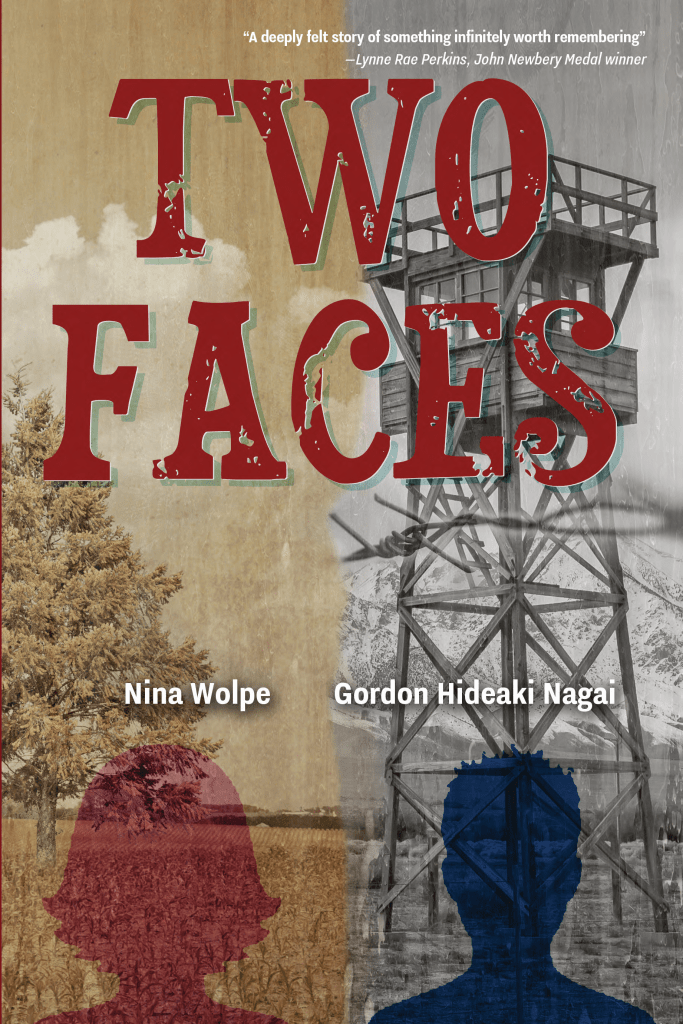
June 1st, a clear sunny day in Bend, Oregon, found me and around fifty others at the Deschutes Public Library for a Two Faces book reading.
My usual approach is to summarize the plot, read the entire first chapter and an excerpt of another that give a sense of the relationship between me and my co-author, and then take questions from the audience. Today, however, while still setting up, a woman approached me, introduced herself, and said, “My stepmother was in the camp at Amache…” My reaction was instantaneous and overwhelming, I burst into tears and wept. I hugged her while the room fell silent. Even after gathering a bit of composure, I was speechless and unable to explain to the puzzled audience.
Liz Goodrich, the library’s Adult Programs Supervisor, welcomed everyone and placed my program in the context of the library’s mission, and formally introduced me.
Because of my earlier emotional response, I switched from my planned program and asked the white-haired attendees if they remembered the bombing of Pearl Harbor. Five or six raised their hands. And when did they learn of the internment of Japanese Americans? Much later for most. I requested a show of hands from any who had learned about the internment during an elementary school lesson. Maybe ten. Who had learned of it during high school? Again, about ten. Lastly, during college? Again, around ten folks raised their hands. Impressive. Most audiences have had very few who learned of the internment at school.
Composure new fully regained, I read from Chapter One: Sunday, December 7, 1941, an early afternoon holiday school concert. After the concert, attendees began learning of the bombing of Pearl Harbor by Japanese naval forces. Gradually an appreciation for the seriousness of the situation grew and townspeople left for home. The chapter ends with a school bus ride the following day and the beginnings of the racial harassment of this protagonist. I concluded my reading with an excerpt from just before my family had to leave, a disastrous outing to a movie for the two friends, intended as a goodbye but one that ended badly when the movie turned out to be a propaganda film putting Japanese in America as spies for the Japanese emperor.
Then I took questions from the audience. Sometimes questions stem from a family connection, sometimes connections of friends, other times from something in my reading or an answer to another question. I usually find Q&A gratifying, and this time, a lively interchange, was no exception. When the questions were all asked, I stepped from the podium and signed copies of Two Faces, speaking individually with many of those who had attended.


 Journeys of a Bent Mind