
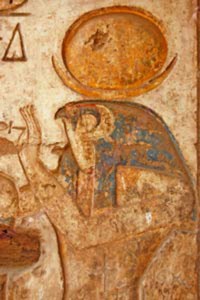
 Tori Jessica Powell had fooled them all – she had graduated Phi Beta Kappa from the University of California in Berkeley, the highest ranked in her class. She had earned the begrudging praise and commendations from leading archaeologists around the world for her groundbreaking doctoral thesis on “Humor and Slave Mentality in the Third Dynasty.” Women didn’t enter the field of archaeology, and they didn’t best males in that brotherhood. In spite of numerous and monumental obstacles in her path, she had done both. So when in the summer of 1937 she began a major dig at Ottokurss on the Upper Nile seeking the lost pyramids of the Third Kingdom of Amen-Hi-Teq, everyone wondered what she would turn up.
Tori’s first assistant for the dig was Paul Chernov, highly regarded Russian anthro-ethnologist. Paul’s specialty was religions of the Upper Nile Valley, specifically those of the Second and Third Dynasties. He had devised a complicated mathematical retrospective decoding algorithm, which enabled him to read the handwriting on the walls of tombs.
The ease with which he had crashed the sacred brotherhood of archaeologists, and literally and figuratively set them on their collective ears, had engendered much antipathy and jealousy among his peers. His self-assured demeanor didn’t help. Tori had selected him for his critical and incisive mind, and his borderline sense of humor.
The third member of the Amen-Hi-Teq dig was noted Egyptian hieroglyphologist, Joseph Behai. Joseph was the author of a most ingenious though controversial approach to the decoding of hidden meanings of once deciphered hieroglyphic texts. His scholarly paper titled “Decoding Hieroglyphs of The Upper Nile From The Third Dynasty: A Second Glance,” appeared in the esoteric archaeological journal, Dig-It.
Together, these three made up an energetic, sophisticated, intelligent, and creative team, and they anxiously set out to uncover the secrets of the pyramids of the Third Kingdom.
One evening Joseph burst into the main tent where Tori and Paul were having a late supper. He had spent weeks working to decipher the mysterious pictoglyphs on the walls and ceilings of the recently opened tomb of Jherq-Ah-Yem III. While clearly in the time period of Amen-Hi-Teq IV, 2300 to 2100 B.C.E., many of the hieroglyphs on the walls of this tomb were enigmatic and unclear, defying time and Joseph’s attempts to coax out their meanings. Joseph loved this part of his work and had been spending long hours in the lower chambers of this, the primary pyramid.
As he rushed into the tent, the two looked up from their conversation. Breathlessly, Joseph exclaimed that he had just uncovered a secret antechamber outside the royal tomb. The three rushed out into the warm starlit evening, and entered the coolness of the massive pyramid. In passageway L-12, just to the left of the main entrance to the royal chamber, Joseph had earlier noticed a slight discoloration in the painted walls. He scraped along the edge of an ever so slight depression, and his knife broke through the thin plaster layering, uncovering a small hidden doorway.
As the full doorway emerged from under several layers of plaster, he could see that the door frame was coated with a layering of gold leaf. The doorway opened with some resistance, and the three ducked and stepped across the threshold into a high vaulted chamber. A cool draft of fresh air struck their faces, and Tori knew a vent opened somewhere to the outer surface of the pyramid. Joseph held up his lantern, and as the light radiated out into the room, three pairs of eyes were drawn up and came to rest on the gleaming ceiling.
The entire surface was coated with gold leaf. Embedded in the gold were hieroglyphs of exquisite design and workmanship, detailing a long “story” from one end of the room to the other. The three stood in amazement. Finally Tori spoke:
“What have we found here?”
Neither of the men spoke, so profound was their awe. Their eyes scanned the storyboard spanning the ceiling above their heads, and all three shook their heads at the wonder of what they were seeing. Tori drew in a deep breath. After what seemed eons, appropriate for where they were, she directed the foreman to have a team move the camera equipment and light stands and one of the generators from the royal chamber to this room.
The foreman hurried off into the shadows of the main passageway. Joseph grabbed a stepladder from the outer passageway and climbed to the upper steps, his face now near the ceiling. Tori and Paul could see the glint of gold reflected in the corners of his eyes.
Joseph was mumbling under his breath, something he did when he felt he was onto something important, and Tori and Paul didn’t miss the fact. Several workmen brought the camera cases, setting them down near Paul, while others set up the lighting stands.
Paul started in the far corner of the little room arranging the lighting for best effect. He loaded high-resolution photographic plates into the camera, and selected a lens that would capture the images on the ceiling without distorting them. He worked methodically, yet quickly. Just as he was aligning the camera and viewing the first segment of the ceiling, Joseph cleared his throat and began humming, and Paul knew instinctively that pieces of the puzzle were falling into place in that head of his.
“What?” asked Paul.
Tori looked up at Joseph, and waited for him to respond. Joseph looked down at the two and beamed impishly.
“C’mon!” said Paul.
“OK, OK!” said Joseph. He pointed to a tall figure wearing a winged hat, and carrying a squarish flat box, indicating that this was Tush-Oh-Mai, a little known priest of the Pharaoh’s high court in charge of science and mathematics. The flat box was something like an abacus that used beads to calculate sums.
“So, what was a low level priest doing with an abacus?” asked Paul. “What calculations would any priest make?”
Joseph indicated that as far as he could tell, it wasn’t being used to do actual calculations; it was being revered as a holy relic.
Paul chuckled and said he wasn’t aware of any society that revered the abacus, although he noted that Oriental cultures have used it in all aspects of their daily lives for centuries.
Tori pointed out that certain cultures did in fact revere objects, and the whole of the society built its secular and sacred lives around that particular object. They were often associated in some way with fertility, invoking powers for the hunt, or dealt with the realm of the gods and the spirit world. Then the holy shaman class devised complex rituals around them to propitiate the gods, or invoke the generative powers of the heavens.
“I can’t imagine them sacrificing vestal virgins to an abacus!” Paul chortled.
“You’re probably right,” said Tori, “but let’s not rule out any possibilities, as absurd as they might sound.”
Joseph pointed to another figure, this one a shorter male with a very tall hat. He wore the regal robes of Jerq-Ish-Mei, court advisor to the Pharaoh, and he too was carrying a little flat box.
“Abacus?” asked Tori.
“Abacus!” said Joseph. He pointed then to yet a third figure. This was a very large stylized male, an Abyssinian by birth, dressed in colorful royal garb and wearing the telltale laurel wreath of royalty.
“Ah, the Pharaoh!” exclaimed Paul.
“The Pharaoh indeed – Jherq-Ah-Yem III!” affirmed Joseph. “But look here,” he continued. And the two looked where Joseph’s finger pointed: there was the Pharaoh sitting on two of these flat boxes, with one foot on the shoulder of each of two prostrate male figures, the very figures who were depicted carrying the boxes in the earlier scenes.
“Obviously, these little boxes were important to the Pharaoh,” said Tori.
“Oh, yes,” said Joseph, “They’re paying homage to Yho-Hi-Teq, the god of mathematics and science.”
“Now, here’s the real puzzler,” said Joseph, and he pointed to the depiction of the Pharaoh: there were two large dark circular objects on his head. “Where have you seen anything like this before?” he asked.
“They look like Mickey Mouse ears,” said Paul.
Tori laughed out loud, and the two men roared with her. Then they stopped laughing, because they knew exactly what that meant.
Paul said it had to be someone recently, then, who had desecrated the holy chamber; this was latter-day graffiti, and clearly someone else had been the first to cast eyes on these sacred walls.
Joseph looked thoughtful, but he disagreed. Because of the manner in which the chamber had been prepared and sealed, and the fact that the gold remained intact within the chamber, the room’s presence couldn’t have been known until he had discovered and opened it tonight; “No, we were the first, I’m sure.”
Tori nodded in agreement, and suggested that Paul complete the photographing of the ceiling, and they would study the photographs as soon as he was ready.
The next morning the three were up with the sun, and pouring over the several hundred photographic plates prepared by Paul through the night.
“Nice work, Paul,” said Tori.
“Thanks,” murmured Paul as he inspected one of the photographs with a magnifying glass.
Joseph mumbled, too, as he scanned one plate after another. Tori said she was beginning to pick up a story line in the photographs, and it was decidedly peculiar.
“The text on the ceiling above is divided into four segments: the first seems to give an historical perspective of the Ottokurss Valley, and gives some background information about the lineage of Jherq-Ah-Yem III. The royal family, the text goes on, descended from the gods, and was once beloved by all the people of the valley. Then came years of hard times when the Nile did not rise above its banks and deliver its nutrient-rich soils to the arid land, and a disastrous drought visited the peoples of the once green river valley.
The second section describes how the hard times took its toll on the people, and saw the people in great distress and suffering. Through this time Jherq-Ah-Yem III deceived the people through beautiful speech, and by taxing them heavily and then diverting the ill-gotten gold into the construction of the pyramids of the Ottokurss Valley as a monument to himself.
The third segment describes how the high priests and advisors assisted Jherq-Ah-Yem III in deceiving the people, and how they placed the mighty abacus on the altars of the temples and required that people pay alms to the priests and worship this computing device. The last segment presents an enigma, for it appears installed by another author. It describes how a certain unnamed slave led a revolt against the power of Jherq-Ah-Yem III and the high holy court. This slave clandestinely modified the design of the royal tomb to include this additional chamber, and he apparently then craftily altered the traditional and classic hieroglyphic texts with what amounted to graffiti. In ancient Egyptian lore, circles were never pictured on or about the head of the Pharaoh, as it was considered sacrilege and a grand insult.”
“It would be comparable today to painting a mustache on a portrait of President Roosevelt,” said Tori, “Except whereas the penalty for insulting the President might bring someone a reprimand and require restitution, in the valley of Jherq-Ah-Yem’s Kingdom, the penalty was death.”
“So why would a slave choose to do something this daring and defiant?” Tori asked. “What would be his payoff?”
“Perhaps it was a way of having the final word in the hereafter,” supposed Paul.


 Journeys of a Bent Mind