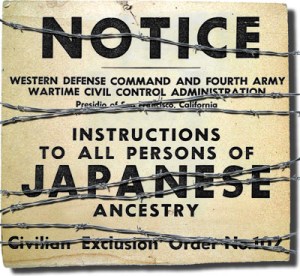
 February 19, 2107: Today marks the 75th anniversary of President Franklin Delano Roosevelt signing Executive Order 9066 that authorized the evacuation and internment of 120,000 persons of Japanese ancestry in concentration camps away from the West Coast. This began one of the darkest episodes of our American story, one of shame and dishonor to the American State and our constitution. History eventually saw the overturning of that initial action as unconstitutional and provided redress and a formal governmental apology on White House stationery to partially heal that error. We celebrate today as a Day of Remembrance lest we forget this lesson in our collective history.
I was recently told by someone that actually the evacuation and internment was needed for the safety of those of Japanese heritage, that there were numerous instances of homes of Japanese riddled with gun fire, and thus this action was a safety precaution for us. Apparently this is a common misconception that abounds even at this date in time.
This was one of the rationales given by the U.S. Army to the Japanese communities as they rounded everyone up for evacuation. 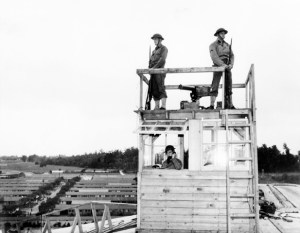 I like to present this photograph of a guard tower – ones like it were posted at intervals around every temporary assembly center where internees were held pending the completion of the construction of the more permanent concentration camps inland, and surrounded those camps that housed Japanese communities from the West Coast for the duration of the war. The area to the right of the tower is outside the barbed wire fencing, that to the left is inside the compound.
We never accepted the Army’s explanation that this action was necessary for our own protection because the rationale was flawed. If there were instances of Japanese homes being fired upon by outraged citizens it was a local police matter, not a military issue. And as a local police matter it wouldn’t have involved mass evacuations to concentrations camps. Secondly, you’ll notice in the accompanying photograph that in every instance, during the detention at assembly centers and later in every concentration camp, the machine guns were pointed inward to inside the barbed wire, not outward. It would hardly be a rational measure for our protection to have the machine guns pointed at us rather than at potential assailants out to do us harm.
The bombing of Pearl Harbor was the ostensible reason for President Roosevelt’s Executive Order, and some would make it a more complex situation than it was. One major factor was racism and prejudice against Asians, and Japanese in particular. Japanese immigrants began coming to mainland America after having immigrated to Hawaii as farm laborers where they quickly assimilated into the culture of the islands. On the mainland they met residual hatred focused on Chinese who had entered before them who had established themselves as formidable threats to American labor in a number of areas. Japanese farmers excelled at their labors and they too earned the animosity and hatred of West Coast farmers. Labor unions and farm organizations with the help of West Coast congressmen mounted major efforts to outlaw farming by Japanese. William Randolph Hearst through his newspaper leveled a hateful tirade in the pages of his paper against Japanese as the “yellow peril” threating American labor and the American way of life.
The prime factor, however, that capped all of the anti-Japanese anger was that Lt. General DeWitt in charge of the Military Western Defense Command harbored a deep-seated hatred of Japanese . His comment, “A Jap is a Jap…!” says it all. In his report to President Roosevelt he indicated there was a clear military necessity for the evacuation and internment of Japanese for sabotage and espionage reasons. This was a patent lie. The Office of Naval Intelligence and Army Military Intelligence Division reported to the president that there was in fact no military rationale to evacuate anyone of Japanese ancestry from the West Coast, contrary to General DeWitt’s reporting. FBI director J. Edgar Hoover also found there were no instances of espionage or sabotage or criminal activities committed by Japanese and he, too, reported there was no judicial reasons for evacuation.
Because of the lie perpetrated by General DeWitt with the intense pressure from farm labor organization and congressional representatives from the West Coast the president acquiesced and signed Executive Order 9066. Subsequent congressional investigations led to the conclusion that the actions taken during WWII were unconstitutional and the result of racial prejudice and inadequate political leadership. The safety of persons of Japanese ancestry was not one of the reasons.


 Journeys of a Bent Mind