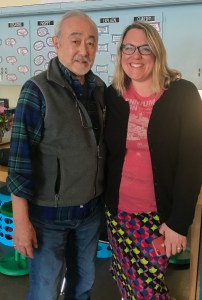
 May 4, 2018: Today I made a second annual visit to the third grade class of a dear friend in Corvallis, Christine Gough. The visit was to share my story of my family’s forced evacuation and internment in a concentration camp in Colorado during WWII. Christine and I know each other from a relationship that began 20 years ago at Marin Elementary School in Albany, California. I had previously been visiting the 4th grade class each year for some ten years of my friend, Diane Lohman that I knew from when I was at U.C. Berkeley in the late 50s. Diane started this sharing of my story by inviting me to meet with her 4th graders as a part of a curriculum unit on WWII she developed specifically about the evacuation and internment of Japanese from the West Coast.
When Diane died suddenly the day after New Years in 1998 a very young Christine Julian took over and in memory of my friend we agreed to have me come to visit this special 4th grade class. We continued annual visits with new classes of 4th graders each year until I moved with my family in 2007 from our home in Berkeley to Eugene, OR. This effectively ended my visits to share my story and my contacts with my friend, Christine.
The Back Story: Diane’s initial plan involved me telling stories and sharing anecdotes of what happened to my family in camp. I spoke for a little bit and the kids asked questions. I spoke again and they asked more questions. I had Diane in advance give each student the homework assignment of asking their parents where their grandparents came from, what was their country of origin? As each child shared their information that day I wrote the country’s name on the board and we ended with an array of countries from around the world. It was pretty amazing. I spoke of the beauty of our country as exemplified on the board, as the only nation made up wholly of people from around the world. And praised our form of government as a remarkable institution because we the people play such a role in what happens. I cited the example of what people did to right the wrong of the evacuation and internment that ended with a formal apology on White House stationery and redress payment of $20,000 to each surviving internee for the injury that they endured.
When Barbara and I moved to Eugene from California in 2007 we were following our grandchildren. Within a short time I established a relationship with a fifth grade teacher at my grandson’s school, Crest Elementary, and resumed telling my story. When Crest closed several years later I continued my story telling in the 5th grade class of a teacher at Edgewood Elementary School nearby.
In 2013 I decided that my story is one that too many adults are unaware of so I developed a full-length talk with PowerPoint presentation aimed at an older audience. I expanded the overall focus of my talk setting my recollections within the context of what happened to the Japanese communities up and down the West Coast.
I initially set a backdrop historical perspective dating back to the late 1880s when Japanese immigrants first came to Hawaii as laborers to work in the pineapple fields. When they came to the mainland they were met with entrenched antipathy against previous Chinese immigrants. Their progress was met with increased anger and opposition from the resident farming population all along the West Coast.
The political response that followed the bombing of Pearl Harbor, engineered primarily by the military leadership in charge of the Western Defense Command, was based on a lie that there was an imminent threat of Japanese invasion of our American shores, and that the Japanese communities on the West Coast posed a credible threat as fifth column spies for the emperor. President Roosevelt accepted the truth that this threat was real and signed an executive order detailing the basis for the evacuation and internment.
The final segment of this PowerPoint presentation covers the remarkable story of how a redress movement born of the Japanese communities gathered support across the country, then in congress, leading to legislation and political steps our government took to address the incident and set forth measures to at least in part resolved the problem: sending of a formal governmental apology on White House stationery, redress payment of $20,000 to every surviving internee, and establishment of an educational fund to recount what happened to insure that it never happens again.
I have given this presentation to adult audiences through the public libraries in Eugene and Springfield, to university students in the history/political sciences department of the University of Oregon, to a fund-raising gathering for the Eugene Opera, to the parents and students of the Eugene home schooling organization, and to audiences at the Osher Lifelong Learning Institute associated with the University of Oregon in their program sites in Eugene, Bend, and Portland.
In 2014 I revised my presentation for a younger audience and have given talks to social studies students at Meadow View middle school in the Bethel School District, and to several social studies sections of juniors at North Eugene High School. In 2017 and again today I gave my edited and briefer talk to a third grade class at Wilson Elementary School in Corvallis of my long-time friend from our days in California.


 Journeys of a Bent Mind