 His parents liked his brother best. He was taller, had that dark handsome look about him, and was smarter than Hans. Manfred Von Richtofen was pursued by the best universities, graduated at the head of his class with honors, and when he enlisted in the budding Army Air Service, his parents were so proud. Hans on the other hand, struggled to get into the university, had a mediocre existence as a student, and returned home upon graduation to join the family business as an apprentice silversmith. Although he wasn’t a rocket scientist, he was skilled with his hands, keen of eye, and with an untrained artistic bent was the creator of the most exquisite pieces of silver his father had ever seen. His workmanship went far beyond anything Herr Von Richtofen had achieved in all his 40 years as a master silversmith. Hans reluctantly accepted the praise he began to garner with his artistic work.
But Hans was unhappy. He spent his long days in the workshop of the family business working on pieces commissioned by wealthy old dowagers – but his heart just wasn’t in it. He was in a place far far away – soaring, a homing pigeon amongst majestic eagles in flight. He dreamed of flying, of being cut from the bounds of earthly ties, of lifting into the air unfettered by the pull of gravity. Flying was still something quite new in all the world, although the thought of flight had teased man from time immemorial. Hans was one so teased, and he ached for the opportunity to ease that ache with flight.
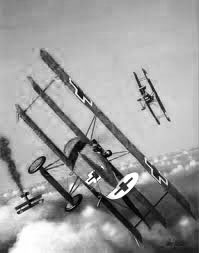
Manfred Von Richtofen, dubbed the Red Baron because of the red cowling on the Fokker D-V he flew, quickly learned the skills to put his wood and silk eagle through incredible paces, and in early encounters with British and American airmen, caused considerable consternation with his aerial antics. One rarely got hurt in those early bouts, mainly because of poor marksmanship with a pistol held outside the cockpit, or aimed into the wind. It wasn’t for not trying, for Baron Von Richtofen was a superior marksman on the pistol range, but buffeting winds, the open cockpit, and the uncertainty in handling these early flying machines, resulted in fly-by shootings with nary a hit. Early machine-guns were mounted on the upper of a biplane’s wings to avoid shooting up one’s own propeller, and were most difficult to aim. But when an aircraft designer one day mounted a machine-gun on the engine housing of Manfred’s flying machine, one synchronized to shoot through a fully rotating propeller, one’s aim improved significantly, and the odds in the exchange of gun fire in the air shot up considerably in favor of the Red Baron and his fellow airmen of the Flying Circus.
Hans loved to hear Manfred tell of his aerial escapades, of his firing his new machine-gun at the enemy, and of the excitement he experienced in the pursuit through the clouds or down among the treetops. He loved to hear his brother’s stories, and was glad for him. But he was sorely jealous, and wished that he, too, could lift off into the wild blue yonder. Manfred, for his part, loved his brother deeply, and wished for him a chance to climb into the cockpit of a flying machine, and watched for every opportunity for him to do so.
Then, during a particularly hazardous sortie over the French countryside, his friend and fellow pilot, Karl Miller, seeking to escape the pursuit of a hotshot American pilot, flew his Fokker D-VI around a stand of trees and into the side of a barn. Miller’s aircraft was utterly destroyed, and he was killed instantly. The squadron leader began the search for new recruits to fill the position in the squadron left by Miller’s death. Manfred gave his superior his brother’s name, and said he was an intelligent and highly skilled craftsman of the air. A wild exaggeration, that. Hans was dumbfounded when his brother told of his being considered to take the new and more powerful Fokker D-VII and replacing Miller. He would be joining his brother in the air. He was excited beyond belief, and after the initial heart-pounding rush, it settled in on him what had just happened, and his knees began to shake violently. He stumbled into the kitchen, and collapsed into a chair. Manfred smiled, and said, “You will be a fine airman.” Hans began to perspire profusely, and shook his head. “I do not know the first thing about a flying machine,” he stammered to Manfred. “Do not worry, little brother. I will show you with my flying machine,” and he beamed a broad smile.
The morning sun peaked over the treetops of the Black Forest, as two dark figures huddled against the cold on the field of the aerodrome. They walked to the front of the lone aircraft sitting on the grassy field, and the taller of the two motioned the other into the cockpit. Manfred instructed Hans in the controls of his flying machine, and once the ignition switch was on, the Red Baron threw his weight onto the broad propeller, pulling downward with one swift movement, and stepped deftly aside. The engine coughed, and belched a plume of steel-grey smoke out the exhausts, and with a sputter, then a roar, the engine caught. Manfred motioned to Hans to move the throttle forward, and the throbbing of the engine smoothed into a mesmerizing purr, and climbed a scale higher and louder. Manfred removed the blocks holding the wheels, slipped under the wing, and coming up behind it, climbed onto the trailing edge and lifted himself up and into the cockpit beside his brother. Hans’ eyes were open wide, a firm set to his jaw, and an excitement burned behind eyes just slightly tinged with fear.
Under the calm and sure eyes of his brother, Hans moved the throttle forward, and the massive propeller drove the flying machine forward. Hans guided the aircraft along the grassy field to the head of the runway, and without a pause, thrust the throttle forward and held on for dear life. The engine roared as an animal stuck, and the powerful engine drove the wooden and silk apparition down the runway, and after a mere eighty feet it lifted into the air. Hans’ eyes filled with tears as he pulled back on the joystick, and the flying machine climbed steeply, every part of it vibrating violently. Hans looked over the edge of the cockpit – the ground was so far below, the trees so tiny from up here. Manfred smiled.
Every day for a month, Hans repeated this routine, and Manfred’s orange Fokker D-VI with a red cowling lumbered briefly down the runway and lifted into the air, and climbed in a long lazy spiral upward until the flying machine was level with the clouds, and Hans could see almost forever. His flying machine touched the clouds and flew as the birds, with the wind beneath its wings. He learned quickly, and Manfred was most impressed and proud. His brother was becoming a pilot of a flying machine, and would soon wear the wings of the feared Flying Circus.
One day the squadron leader approached Manfred and asked that he tell Hans that he wanted to see him. Hans was excited, almost as much as Manfred was. Together the two brothers arrived at the headquarters building at the aerodrome where Hans was formally invited to join the flying squadron. When he accepted, he was led out to the field where a brand new Fokker D-VII sat, its fresh paint shining in the early morning light. The new flying machine had green and orange markings, with white square patches on the ends of the upper wings with the black German cross filling it, and the cowling over the powerful engine was a distinctive light purple. Manfred laughed, and dubbed Hans the Lavender Baron. Hans beamed with pride, and chuckled with his brother.
Dark clouds were scattered across an early morning sky when the call came for the members of the Flying Circus to take to the air for their most dangerous mission yet. Manfred knew that the British and American flyers would be up in large numbers, and he worried for Hans, who was still a green recruit. Flying practice sorties over the lush fields of the Rhine Valley was one thing – the stakes today were considerably higher, and he hoped that Hans would be up to the task at hand. Before he climbed into his aircraft, he threw an arm across Hans’ shoulders and wished him luck and good hunting. Hans returned the wish, and climbed into his flying machine. He sat back, and threw his silk scarf around his neck. It was time.
The air at the higher altitudes was freezing cold, and Hans clapped his gloved hands together to warm them. Manfred had warned him to wear his long underwear, and he was glad for the brotherly advice. The drone of the powerful engine drowned out all sounds, otherwise he was sure the other flyers would hear his teeth chattering. Hans glanced over to his left, and waved to the Red Baron – he smiled, and in the brisk thin air Manfred smiled back.
Hans caught movement out of the corner of his eye, and saw Manfred waving his arms, pointing up and to the west. Hans followed the direction of his gesturing, and saw the glint of sun off of something metallic high above him. Gun metal, thought Hans. That was something he had transferred to his new line of work from his knowledge of metals as a silversmith. “Oh, boy,” thought Hans to himself, as he tightened his grip on the joystick and pulled back ever so slightly. The nose of his flying machine came up and pointed toward the flight of aircraft coming in his direction. Hans unsnapped the leather strap holding his Luger pistol in its holster.
All of a sudden the whine of high velocity bullets filled the air around him, and Hans heard the fabric of his aircraft taking hits. Hans pulled sharply to his right, and rolled over and pulled hard up into the sun. As he came out of his roll, he saw the blue-grey coloring of a Spad flying machine flash by him, the Hat-In-The-Ring insignia of the 94th Aero Pursuit Squadron on its side. Hans’ blood ran cold. Here were the flyers of the American Air Service led by Eddie Rickenbacker that Hans had heard of, and fear seized his mind. Again he heard the buzz of bullets whistling around him, and again he pulled up and over, then into a steep dive, spiraling downward with the ground rushing up at him with incredible speed. He heaved with all his might on the joystick, and pulled out of his dive just 20 feet off the ground. Looking back, the blue-grey Spad was still on his tail.
The way the pursuer was glued to him, Hans knew it was the hotshot American pilot, Tommy Nelsbutt. Nelsbutt was a cocky young flyer, born in California, but raised in Texas. He was bigger than life, and so full of himself, with a dark side to his personality that came out in spades. Skilled with words and with a superior intellect, Nelsbutt used a cutting tongue in his dealings with everyone. His best friend and fellow pilot, Jimmy Burrtone, was also a Californian, but raised in the rural outbacks of Oregon. He was a social isolate with the social skills of a rock. Uncomfortable around others, his responses, too, were often hurtful to them. Nelsbutt’s and Burrtone’s skills in the air, however, were astounding. They flew as though the wood and silk of their aircrafts were the sinews and feathers of their arms and shoulders. They anticipated their adversaries in ways a human couldn’t, or shouldn’t – and appeared in places that weren’t possible – yet, there they were. Between them they had seven kills to their names, and it was still early in the war. Hans knew when Nelsbutt was around, Burrtone wasn’t very far away. Here was trouble, spelled double.
Hans could hear the faint chatter of a 50mm machine-gun above the roar of his own engine. He throttled full up, and pushed his flying machine toward a bank of clouds. All of a sudden, he heard metal striking metal, and a tremendous pain shot through his body. His cockpit began to fill with black smoke, and his engine began to sputter and cough. Hans could see a thin streak of black oil sputtering out of the side of the engine compartment in front of him. His left side was numb, and he had difficulty lifting his arms to control the joystick. Then, a red flying machine flew dangerously close and between Hans and the pursuing American, forcing the pursuer to pull up to avoid a mid-air collision. As the blue-grey flying machine pulled up and passed in front of the Red Baron, Hans struggled and pulled into a momentary stall, and came around just in time to see Manfred falling in behind the American pilot. Now the Red Baron was the pursuer, the American the pursued. Manfred fired his two machine-guns with deadly accuracy, hitting his target just behind the propeller, and raking it full along the side. The American slumped forward, and his aircraft slipped into a dive toward the Channel, trailing a thin but growing streak of black smoke on the air.
Hans’ flying machine fluttered like a bird struck by pellets, and began a slow spiraling descent toward the ground below. Hans’ left arm was useless, and he was too weak to manage the controls. Manfred followed his brother’s crippled airship down, and watched as it gained speed and slammed violently into the side of a hill. Shaken, but now angered, he began climbing once again and rejoined the combat with the British and American flyers. The Red Baron pulled in behind the blue-grey Spad of Burrtone, and playing with his cocky enemy, fired a burst into his wing struts, weakening the wing structure. Burrtone winced on seeing the damage to his aircraft – his eyes grew wider, as the pursuing avenger stayed with him in spite of his efforts to shake him. The Red Baron fired another long burst, this time hitting the engine and propeller of the American’s aircraft. The aircraft began to shudder and wobble violently, and Burrtone struggled to keep the crippled flying machine in the air. Manfred watched as Burrtone pulled frantically on the joystick, and smiled as flames began to eat away at the silk around the engine housing. He followed the crippled and burning aircraft as it spiraled down out of the clouds. Just as the blue-grey Spad approached the crest of a hill, Manfred fired one final burst of his dual machine-guns into the dying aircraft, and watched as it exploded on impact with the ground. “That was for Hans,” he whispered through his teeth. The Red Baron pulled out of his deadly pursuit, and brought his eagle up into the sun. He climbed in a long lazy spiral upward until the flying machine was level with the clouds, and he could see almost forever. Hans’ flying machine had touched the clouds and he now flew as the birds, with the wind beneath his wings…


 Journeys of a Bent Mind
enjoyed, exciting, thanks Gordon,
LikeLike
It was a fun story to share…
LikeLike