I am beginning work on a phantom volume to supplement the eight singlet volumes of puns I collaborated on with my four grandchildren as illustrators, and the two volumes of puns published by Ulysses Press out of Berkeley, California. I explore the mind of an introvert as the source of the word-play in these published works, and venture into the realm from whence all such creativity and playfulness comes.
 Preface
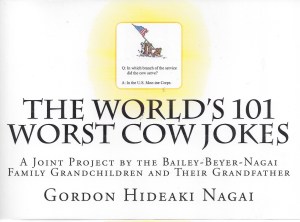
Beginning in 2013 I embarked on a fun project with my four grandchildren, one that involved me writing a set of dad jokes, and they creating illustrations for select ones of them. I wrote puns, they drew illustrations. We self-published our first volume of 101 puns that year under the title, “The World’s 101 Worst Cow Jokes.” For us it was a most moo-ving achievement. There followed, over the course of the next two years, seven more volumes of “The World’s 101 Worst Puns,” self-published through CreateSpace, a subsidiary then of Amazon.com.
I have gathered for this current study the introductions for those eight books in order to explore the mindset of an introvert, to show the inner workings of a not so subtle and thoroughly manic mind, one totally not under the influence of any chemicals, trust me, but in straight out zaniness unfettered. My intent with each introduction was to set a context for the puns that followed. For the most part I think that worked, and each time the essays revealed the inner workings of a bent mind, the thinking of a die-hard wordsmith – me. Really, no chemicals.
Puns are an acquired taste, and in a somewhat oblique fashion, they are a window into the mind of the punster. In presenting here the introductory words and a sampling of dad jokes from each volume, it is my hope that you get a peek down the rabbit hole of my mind, to see how it functions. However, do be forewarned that the Queen of Hearts and I have a lot in common. This is a realm where, in the quietude of my introversion, gems of ideas collide, thoughts stretch and contort just for fun, and words burnish meaning in order to storm the bounds of humor. It is my safe place, my retreat from whence word-play flows.
Introduction: The Uncommon History of Puns
Words are a fascination and a wonder unto themselves. They were by far the most important of all inventions of our early ancestors. Words are but a set of letters strung together with a specific sound associated with each letter. They represent something we’ve come in unison to agree about, and hearing those sounds, we know we’ve just experienced a word – or a sentence – and we understood.
Consider how this all came about – In the far reaches of time past, in some dark corridor of pre-history, a gathering of creatures moved about the landscape seeking food and shelter from the elements. Language hadn’t been invented yet, so they grunted a lot and made hand gestures, and a lot had to have gotten lost without any defining moments. Eventually they vocalized certain sounds consistently over time for specific things, and gradually “words” were invented. This was perhaps the first time understanding occurred.
Then, over some incomprehensibly long stretch of time, more words came into use because more things needed to be addressed, and the developing mind took note. Social media hadn’t been invented yet, but something akin was happening that allowed some artists to use charcoal and pigment to picture horses and bison on the walls of caves. Today’s descendants of those artists post memes of cats and dogs on the walls of social media.
By the time we humans were able to string together a lengthy stretch of words in sentences, things were becoming easier to deal with, and frustration levels diminished considerably. In those spare moments between hunting and gathering, and later yet, after a long day tilling the soil, the wisdom elders told stories around the evening campfires about the early days, and oral traditions were established.
It is supposition, but I believe that during all these formative years that fathers, all along, were the court jesters and class clowns of their era, and dad jokes salted all of the conversations and interchanges among peoples of their tribe. I don’t know when exactly the word pun came about to describe these afflictions of humor, but no matter, everyone knew once dad started, you couldn’t stop him foisting some cringeworthy bit of humor on those within earshot. I believe this was when medicine men and shaman came up with the diagnosis of “Play-on-Words Syndrome” that described the involuntary groans they elicited, along with the side-effects of the rolling of the eyes, and smirk of painfully humored lips.
Puns are considered by some the step-sister of all humor, and they keenly love to outright hate them. Others, however, myself a key believer, consider them a more sophisticated class of humor, a form distinctive for its cleverness, subtly, and treachery in the lurking surprise. By my count we don’t give proper acknowledgement to the purveyors of word-play, those speakers of yarns, the teller of tales, who deliver us dad jokes. Think of the work of these pages as a window on the thoughts and mind of an introvert seeking to remedy this void.
Back Page: Author’s Bio
I am a retired social worker who, as a professional, served clients with mental health diagnoses, and those with developmental disabilities. I retired early in January 2000 following a heart attack, and when Barbara retired in 2007, we followed our children and grandchildren from California to Eugene, Oregon.
I have spent a lifetime as a wordsmith, fascinated with the world of dad jokes, clever plays on words, of puns. I love words that sound the same, but are spelled differently, e.g. – your, you’re, and yore; and those that are spelled the same, but have different meanings, e.g. – lead the metal, and lead the verb.
I am fortunate to be the author of two books of puns, The Ultimate Book of Dad Jokes, and Born to Pun, published by Ulysses Press in Berkeley, CA, and 8 singlet volumes of puns self-published with my grandchildren through CreateSpace titled, The World’s 101 Worst Puns, Vols. I-VIII.
I am an honorary member emeritus of the Grammar Police Association, and I pun for my mental health.


 Journeys of a Bent Mind