
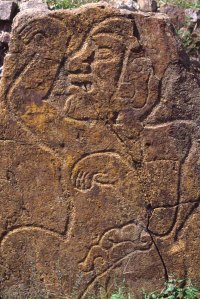
The sun rose and broke through thunderheads gathering to the east. A storm was brewing, and Dr. Drake Eullah knew his team had only hours to complete the first stages of a most important dig. His colleague of long standing, Dr. Sarah Grimsby Repuhr, had long suspected the existence of this complex of ancient burial mounds and ceremonial sites in the remote St. Claire mountain range, high in the South American Andes. The two world-renowned archaeologists were opening new chapters in their studies of ancient civilizations, hoping to add to the sparse knowledge about the little-known Tuwedh people of the Andean highlands. This band of nomadic peoples was remotely related to the long-lost Nohwedh peoples, which, it was believed, disappeared and was assimilated into the dominant Andean Arwedh culture.
The Tuwedh peoples appeared to be quite similar to the Arwedh culture in virtually all respects. Ancient artifacts and petroglyphs point to a people generally indistinguishable from the larger cultural context. They were described in legend as having inhabited a localized area in the eastern reaches known as the Valley of Large Rocks, but newly discovered artifacts and petroglyphs from the St. Claire site suggest these peoples had at a later date migrated westward to the Andean coastal regions. The excavation at the St. Claire site was a source of great excitement in the archaeological community, for, while speculations had surfaced for years about this nomadic people, there was little in the way of concrete evidence to confirm their presence this far to the west, or to describe their social structure, religious practices, and actual day-to-day activities.
The St. Claire dig team’s extensive efforts pointed to this being a highly industrious people, as noted in the variety of artifacts found at the various excavation sites. At the eastern location in the Valley of Large Rocks, large stores of tiny bricks, hewn from larger blocks of black granite, had been unearthed. These flat bricks were found standing on end on long shelves, and dig teams unearthed large quantities of these miniature granite blocks. The function and purpose of these blocks remains unclear, for they were not utilized in the construction of any buildings, walls, or other structures.
Dr. Repuhr spent considerable time deciphering one enigmatic petroglyph in an inner chamber thought to be the spiritual center of the region, depicting a flat rectangular receptacle into which these bricks were placed. There was speculation amongst Dr. Repuhr’s team members that these flat granite pieces were used in religious ceremonies to enhance one’s spiritual vision, but it was unclear from the petroglyphs just how this was accomplished. Similarly, in the western region along the coast, in the St. Joseph Valley to the south of the St. Claire Range, the local Tuwedh workers had produced large quantities of mud bricks made from the hard clays dug from along the St. Joseph river. These adobe bricks, unlike the small granite blocks found in the eastern locations, were used in virtually all construction up and down the length of the high Andes, and apparently were considered the premier building blocks by indigenous peoples.
Artifacts unearthed along the shores of a large protected bay, indicated that the Tuwedh group had also settled in this region for a time. The weather was temperate, moderated by the large expanse of the bay itself, and even during the harshest of winters the waters never reached freezing. It is unclear what constituted the diet of this people, but recent discoveries of bone fishing hooks and remnants of hemp netting suggest a diet consisting of fish and other marine life, in addition to the variety of edible wild plants found in the low lying marshes of the inner bay.
The Tuwedh society also left numerous artifacts and structures thought to be religious in nature. The most curious and by far the most impressive were huge edifices on the low-lying mud flats adjacent to the bay, built of green obsidian mined from local quarries in the nearby Andean foothills. Dr. Eullah believed this series of green mounds represented a monument built to a god worshipped by the Arwedh and Tuwedh peoples. Obsidian, usually black and glass-like, was valued by ancient peoples for its simple crystalline beauty, and its usefulness as a cutting edge tool.
Dr. Eullah’s research suggested a link between green obsidian and ancient religious beliefs associated with tribal shaman, sages, or oracles, who in legend and by tradition served as gatekeepers to the spirit worlds. Paintings found on the inner walls of these structures depicted what Dr. Eullah believed were religious ceremonies paying homage to a local deity with an all-seeing rectangular eye in the middle of its enlarged forehead. This god, according to the wall paintings, lived on the uppermost level of the tallest of the green mounds, very likely a representation of the high Andean peaks.
Dr. Eullah’s team additionally discovered a curious link between the green obsidian structures on the marshy flatlands neighboring the inland waters, and several high locations on mountain tops surrounding the protected bay. These elevated sites were cleared of trees and leveled, leaving a line-of-sight view to the bayside structures. At each of half a dozen such sites were found quantities of tiny rectangular pieces of green obsidian, their surfaces polished to a high sheen. Dr. Eullah believed these devices, when fastened together on flat boards, served as giant mirrors, and with the use of reflected sunlight, connected these elevated sites with the central obsidian mound in a weblike network of instant communication. Communication in this manner would have been simpler, quicker, and more direct, than through the use of smoke signals, flags, or message runners. It was unclear whether this communications network was utilized for defensive purposes to warn of the approach of enemy warriors, or for some other perhaps more esoteric reason. Dr. Eullah believed there might have been a combination of purposes for this curious communication system.
Dr. Repuhr’s primary efforts now focused on the St. Claire excavation site. It was here that her extensive research into the Tuwedh culture began to show significant results. Artifacts unearthed at the St. Claire site gave strong support to Dr. Repuhr’s belief that the Tuwedh peoples held a formal religious gathering in this valley prior to their disappearance. Much like their earlier counterparts, the Nohwedh tribe, who celebrated one final spiritual ritual at the Clear Mountain location to the north just prior to their disappearance from the region, the Tuwedh people appeared to have held a series of celebrations over the course of several days, culminating in the union of two of its high holy celebrants. The Tuwedh peoples then vanished from the region, leaving only signs of the dominant culture of the Arwedhs.
Petroglyphic evidence suggests that on the day immediately before the high holy celebration, in accord with supposed precepts of the patriarchal Arwedh society, the Tuwedh people gathered for a simple ceremony involving some sort of banquet. Artifacts unearthed at this ceremonial location suggest the families of the celebrants, together with several officiants, came together informally, but with practiced skill, for a purpose as yet unclear to either Dr. Repuhr and Dr. Eullah, or to their team members. Petroglyphs on the walls of the informal ceremonial site suggest the gathering was presided over by a high holy female officiant, a rare occurrence in religious traditions throughout the patriarchal Arwedh culture. The gathering appeared to be festive, fine foods were served, and ceremonial wines flowed freely, as suggested by the large quantities of vessels present which traditionally were used to store fermented beverages.
Dr. Repuhr concurrently completed the deciphering of extensive petroglyphs found at another site known to local indigenous peoples as the Village of the Mountain Volcano. The high holy celebration apparently took place here in a secluded valley nestled among tall stately trees, surrounded by vast rolling grasslands. Evidence suggested that the ceremony was held in an enclosed area surrounded by Grecian-like pillars and delicate flowers. Dr. Repuhr reported her translations of these petroglyphs, indicating that a local craftsman and artist had been charged with establishing a pictorial record of the high holy celebration.
The existence of an extensive pictorial record chiseled painstakingly into the soft rock surface aided the researchers in their quest to understand the Tuwedh tribe, giving much needed insight into this enigmatic peoples and the import of this particular celebration within the dominant culture. Dr. Repuhr suggested the marriage perhaps was for the purpose of consolidating power in the region for either political or religious purposes. Dr. Eullah, however, expressed caution and some doubt, indicating that while the two celebrants represented large and powerful families, one from the southern high Andes, the other from the northern regions of the high Andean plateau, there was as yet no confirming evidence among the artifacts and pictorial record to suggest such reasoning for political or religious linkage.
As the St. Claire dig team was concluding its work at these sites, a worker inspecting the region near the marshlands, happened upon yet another site he believed was related to the high religious celebration. The dig team shifted its focus to this new site, discovering remnants of thin redwood slats in the upper layers of soil, along with pottery shards similar to those of containers of ceremonial wines found at the Village of The Mountain Volcano site.
Several pieces of finely woven fabric were found remarkably preserved in the hard clays of the marshland, indicating that the Tuwedh craftsmen had mastered the art of fine fabric weaving. The fabric was of a pure white silken quality, suggesting, according to Dr. Repuhr, that these were perhaps remnants of the ceremonial wedding garb of the female celebrant. At the four-foot depth, diggers discovered two ornamental rings, hand hammered into brilliant circles of burnished gold.
The quality of workmanship of these pieces of jewelry indicated these were important personages in the Tuwedh tribal structure, suggesting again that the marriage may have had political as well as religious considerations. Dr. Eullah continued to express caution, suggesting the artistry of the fine pieces of jewelry may be more a reflection of the tastes of an artistic people.
There were no indications that these peoples were warlike, or had any inclination toward the taking of territory or the wielding of power. Nor had there emerged any confirming artifacts to suggest that the communication system had defensive or political purposes. Dr. Eullah suggested instead that the communication methods, the fine artistry in jewelry making, and the mastery of fine fabric weaving, not to mention the industry of artisans who created the variety of building materials, pointed to a peaceful and industrious society, one more atuned with the earth, the environment, and the leisure of a peaceful people.
The puzzle remains, in the end, as there is little in evidence to suggest what actually happened to either the Nohwedh peoples, or their latter-day cousins, the Tuwedh tribe. In their dedication, Dr. Repuhr and Dr. Eullah continue their research into the disappearance and suspected assimilation of these two tribes into the greater Arwedh culture.


 Journeys of a Bent Mind