What follows is a journey through the golden meadows of my memory – a look at my Dad in tales and anecdotes and memory traces, in no specific order – word images that flesh out and define the man who defines me so thoroughly…
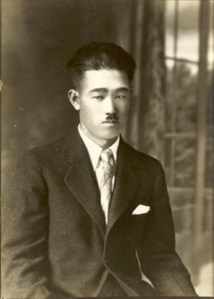 Silence. Deep silence, and a firm set lip. Large brown eyes with a glint of spirit and whisper of darkness within them. He was a man of the earth – he had dirt under his fingernails, and mud on his work boots, even when he cleaned up. You felt it from the time he clasped your hand in a firm handshake, for his large hands were hard and callused from an age of hard labor. Yet, he was able to tie the most delicate of knots with the slimmest of fishing leader. He mostly wore khakis and a heavy cotton shirt in the fall and winter time, with an orange zippered sweatshirt for warmth, and a weathered and crumpled sweat-stained hat. In the spring and summer, khakis and a white T-shire. He was big-boned for a Japanese, though in stature he wasn’t tall by any measure. Still, he was taller than I was to become on my American diet.
Silent with an outer calm, but with an intense inner world the verge between the deep of mystery, and delicate almond blossoms in spring – that was Dad. In so many ways an enigma, yet also somewhat of an open book. He was not a man of words, but it was clear his take on things of import. Extremely courteous, yet not obsequious; uneducated, but knowing in matters of living; tough in the face of challenges, yet tender in his relationships with his children – conscientious, steadfast, and true.
It was a hard life growing up on the farm – not bone-crushing hard, or so severe as to destroy the spirit, but hard enough to build character, as they say. Days on the farm were long – sometimes you rose before sunrise, worked through to twilight and into the night, and in between you went to school. And, there were always chores. But, there were softer times as well – times for family. When we were younger we piled into the car and took off on Sunday drives, something long lost in the misty past. Sometimes we visited family or relatives, sometimes friends. Sometimes we just drove with no destination in mind. It was like being in a time capsule just with family and for a child it was exciting. The first car I remember was a powder blue Plymouth – four doors, big and boxy, running-boards on the sides, with that sailing ship hood ornament. The back doors, as I recall, opened the wrong way. Dad always drove – that was the way things were then. During the winter we still went driving, though we kept the windows closed to keep us warm and dry. In the late spring and into summer, when the weather warmed and the harvest didn’t conflict, we drove with the windows down – that was our air conditioning – it was called the “4-60” A/C model; open all four windows and drive 60 miles per hour. No, it’s true – someone came up with that name.
Family wasn’t just important, it was everything. It was where you did things with and for the family. It was where we learned what it meant to be a Nagai, and how to be a Nagai. The first time I elected not to go with friend to hang out at Lake Merced on a Saturday, and instead stayed home to work, was a proud day for Dad – it meant something. We all had our chores, and the expectation was that you carried them out. For the most part we all did, because family was important to us kids as well. We were a close-knit family, and there is no doubt that was partly the result of being one of only two Japanese American families in the community after WWII. During our time in the concentration camp in southeastern Colorado Mom and Dad did everything they could to keep us tight as a family, to protect us children from the horrors of the war, but also to give us as normal a childhood as possible under the circumstances. Our family came out stronger for their efforts.
It’s pretty amazing how a feeling for family develops – it’s a compilation of a thousand factors, some major and obvious, other so subtle you hardly know they’re working on you. Mom and Dad set the tone in the house, and guided us as we made our way into the world outside the home. Then, too, there were so many adults in the community who knew Mom and Dad who made up a much larger extended family, that if they ever caught us stepping out of line, word reached home well before we did, and we had the privilege of explaining ourselves with our first step inside the front door.
Dad went to school in California when he first arrived from Hiroshima, but attended only for a short time. He left school at an early age to work to help put his older and favored brother through school. Because his schooling was short, he didn’t learn English well, and for the rest of his life spoke in what we familiarly called “broken English.” Those who didn’t know him well initially had a tough time understanding him. As I was growing up this was a source of embarrassment for me, but in time I grew to see the courage it took for him to live in the world after the war. As far as family values and moral standards went, though, we understood Dad very well.
As I’ve said, Dad wasn’t much for talking. This in part was due to a personality type that encompassed introversion and deep thought, compromised by English being his second language. When it came to giving an explanation or involved conversation, he was often at a loss for words. I recall one freezing cold day when he was teaching me how to prune fruit trees – we were standing some 10 feet above the ground atop a flatform attached over our tractor, There were iron guard rails to prevent our falling off, with remote controls to work the clutch, brake, gas, and steering mechanism, permitting us to drive the moving platform from tree to tree without having to descend to do that.
Dad pointed to a place on a branch and said, “Cut here.” I asked, “Why there?” His face stoic and giving no clue as to what he was thinking, he paused searching for words to explain: “That where you cut.” Pause: I said, “I don’t understand why you cut it there.” He continued on: “Cut here.” Dad was uncomfortable; I was uncomfortable, and I didn’t ask any further. Needless to say, I didn’t learn the art of pruning trees that day, or ever after.
In later years in a moment of inspiration it occurred to me that it had to do with pre-thinning enough buds from along the branch to prevent there being a surfeit of fruit at harvest time. Too much fruit on a single branch, and they’d be smaller and the sugar content lower. At the time, I didn’t understand any of this. In hindsight, I felt for Dad as he tried to explain to me an art he had mastered, but couldn’t find words to describe. Maybe if I’d spoken his language he might have come through.
Dad was a farmer, and connected to the earth. His family and the families in this line back through time were all farmers. As I was growing up there was a tale about family that involved Dad’s parents, my grandparents on his side. At that generational juncture, a male of the Samurai warrior class entered this line. The story went that the Nagai family at that generational point had only daughters, no sons. This meant that the Nagai family line would end with the daughters marrying off into other families, and the Nagai family would be no more. As frequently happens in such cases, the Nagai parents arranged a marriage of one of the daughters with a young man of another family, the Sagawa family of a warrior class, and the young man took the Nagai family name. Thus, the Nagai line continued in time. There is, however, an ironic twist to the story: the Nagai daughter died before bearing a child, and the Sagawa now named Nagai married another. In fact, then, the Nagai family did continue in name, but not with the Nagai blood line. Today’s Nagai family is really the Sagawa family blood line. I learned this well into my 60s, and for all those years never understood our close relationship with the Sagawa family and why we visited them so often.


 Journeys of a Bent Mind