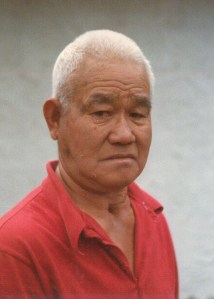
 Dad was an artist of sorts, with an appreciation for the aesthetic – not that he would have been able to verbalize this. Here’s my take on Dad being an artist: while most farmers in post WWII central California maintained a “co-existent” relationship with weeds, meaning they “let them go,” Dad aggressively sought to eliminate them. This was expensive and time-consuming, but it was something he did. This meant we sons did. Weeds do two things not good for crops: 1) they take moisture and nutrients from the soil that should go to the crops; and 2) they detract from the aesthetic look of the orchards and vineyards. The first is scientifically based, and I credit Dad for having this perspective given his education. The latter had nothing to do with science, but was more impressive to me as a closet-artist growing up. A clean orchard was pretty impressive. Of course, the down side was that I spent many an hour hoeing weeds by hand, and hours on the tractor wielding a disc taking it out on all those weeds. We did, though, have a clean ranch as a result.
Dad had this incredible internal alarm clock that modulated his life as a farmer. He did have an alarm clock on the night stand beside his bed, but never used it to my knowledge. He rose unaided when he needed to, for example at 3:00 in the morning when the ditch buck said we had the water. Regardless of the time, he arose unaided and went off to work – I never figured out how he did that.
One Thanksgiving after I’d been married a couple of years, the whole family gathered at the old homestead for the holidays. Gene and Cindy were there, David was up from college, Barbara and I were in from Berkeley, and Janet and Hank came up from Fresno. Crowded, but cozy. Very quickly a pinochle game started in the living room, and a strange thing happened – the game took on a monster quality all its own, devouring time as had never happened with any event in the family ever before. That first day we must have played 5-6 hours straight. The intensity of the game was palpable. The next day, it resumed for another 6-hour marathon, and we barely stopped for meals. Dad wasn’t pleased, in fact was really angry, and finally called us on it. We, none of us, had been helping out in the kitchen, neither in preparations nor in cleanup. Chagrinned, we pitched in to help Mom out – we were late, but still, we were having fun, and Dad was right.
Dad was an equalitarian at heart – traditionally, the Japanese father is the master of the house, and his wife takes her “rightful place” to the side or several paces behind. Not so with Dad. He and Mom were equals, and shared everything in their lives. They worked side-by-side throughout the year. In the fall and winter, they pruned the fruit trees and grape vines. They each drove the tractor and disc whenever needed, and in the summer brought in the harvest. And, when the ditch buck said the water was ours, they went out to “chase water.” Together they built our first home after the war when we returned home from the concentration camp in Colorado. Dad and Jiichan, Japanese for grandfather, poured the foundation, raised the framing and walls, affixed the roof and did the plumbing, while Mom did all the electrical wiring. I don’t know how Mom knew about electrical wiring, but the point being, it all worked and passed code. Mom also did all the cooking, so had that job on top of being a gentle-woman farmer. Dad helped out in the kitchen, maintained the vegetable garden, mowed the lawn, helped with the laundry, kept the chickens, and made sure the family car was maintained, as well as all the other farm equipment. While Dad wasn’t overtly an emotional or demonstrative person, those occasions in the kitchen gave light to his manner of saying to Mom, “I love you.”
I’m a lot like my Dad – an introvert with a world of things going on inside, though you’d hardly know it to look at either of us. Basically shy, stressed if called upon to speak in public, dislike of large crowds, especially of people we didn’t know, or knew only a little, hopelessly sentimental, liking of simpler things, and family. I love family. Dad loved family. I am so like my Dad.
Irrigating orchards and vineyards is one of the most solitary tasks on the farm. Dad often woke up in the middle of the night to accept the water, and worked through the day till twilight with only brief stops for meals before he set the water for the night. This meant opening the valve of the standpipe to allow just a trickle to run, and if set just right that trickle reached the end of the row by morning.
We set water for the night throughout the orchard. In the morning Dad would open the valve and route the water into the next row. When I worked with Dad irrigating we rarely spoke, in part because we often were working different sections of the orchard, but also because we both were inner silent types. We sometimes didn’t see each other until lunchtime when we sat down for the mid-day meal. Pretty much uneventful, this task, but it required a level of vigilance in case one of the furrows or levies broke sending water in the wrong flooding and uncontrolled direction. Once there was a break and flooding began, it involved shoveling a large amount of dirt very quickly to fill in the breech in the levy to bring the flooding under control. Did I say solitary? For an introvert these were prime times, and I spent the time deep in that wonder-filled world of the inner while chasing water in the outer realm. I loved the time by myself; Dad seemed to take it in stride.
Dad was a nominal Buddhist, but wasn’t a practicing participant when he came to this country. He nevertheless held strong moral values that had to do with right and wrong, that came out of a family and culture of doing what’s right, honoring your parents and elders and those to whom respect is due by office, position, or merit. It was obeying the law, doing right by family, giving full measure in everything, and especially working hard, giving service, appreciating your life and the benefits you receive, and giving back. The power of family.
When I took a stand as a conscientious objector in graduate school, a time when the Vietnam war was just heating up, but before it became somewhat official, this was a very difficult time for Mom and Dad. Here I was, their first-born son, and I was doing something that in their eyes and life experiences during WWII resulted in people going to prison. To Japanese, to break the law, to defy authority or show disrespect, especially if against the rules of society, meant the loss of face, the dishonoring of the family name, and bringing shame upon the family. Major taboo, this. I give a lot of credit to Mom and Dad in spite of such conditioning and emotions that ran so deep. They stood by me during this trying time.
People can change. I’m not absolutely convinced of this, and being somewhat of a cynic I hesitate to say it, but it seems to happen enough that I’ll allow how it might be. When I asked Barbara to marry me, we knew we were going to encounter some difficulties, not the least of which was with our own families. Inter-racial marriages weren’t all that common in the early ‘60s, at least in our circles. When I told Mom that I had proposed to Barbara, I casually slipped in that she was Caucasian. There was a pregnant pause – Mom: “I had hoped you would marry a nice Japanese girl…” Ouch! Barbara’s Mother’s response was similar: “I had hoped you would marry an American…” Barbara answered: “Mother, he IS an American…!” Well, so much for smooth beginnings in our marriage.
However, with the birth of our firstborn, Paul, you would have thought we had enjoyed full support of parents from the start. Paul’s innocent cute face, his big brown eyes and long eyelashes, shock of thick dark hair, that amalgam that is expressed so eloquently in the faces of mixed-race children, touched something very deep in the new grandparents, and they were summarily won over. Whatever residual racism that existed on both accounts, melted away on seeing the alert and shining face of a grandson. Being a grandparent now myself, I fully understand how that works.


 Journeys of a Bent Mind