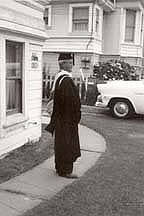
 In 1963 I earned my Masters in Social Welfare degree from the Graduate School of Social Work at the University of California in Berkeley. Mom and Dad came up for the ceremonies held in the U.C. football stadium on the Cal campus. Before the ceremonies, Dad stood in front of our basement apartment on Wheeler Street and had his picture taken in my mortarboard, and master’s gown and hood. He was so proud – my graduate degree was the highest anyone in the family had achieved.
In 1948 President Harry Truman signed into law the Japanese American Evacuation Claims Act, designed to provide reimbursement to those incarcerated during the war for losses in income and property. Mom and Dad received an amount of $500 on their claim of $12,000 in losses. Mom’s comment on receiving this amount: “It just barely covered the cost of a new pickup truck.” The disappointment and anger was always in her voice when she spoke of it, later to be replaced with resignation – “Shikata ga nai…!” “There’s nothing you can do about it…” Dad I think was just glad to get anything for the family’s losses.
Discipline: Here’s the thing – neither Mom nor Dad ever laid a hand on any of us kids, they didn’t have to. With a raised eyebrow, that tone in the voice, a certain look or a choice word, and we fell right into line. These were things that stung more than a ruler on the backside or the back of a hand to the head. They were most effective in molding our behavior. The downside was it instilled guilt as a motivator – the words, “You should know better…!” still ring in my ears.
Trust: from very early on Dad allowed me to drive all the various farm equipment. This included an ancient Case tractor that required that I jump on the clutch pedal to operate it in conjunction with the heavy gear shift because of my slight weight and stature, a Ford tractor, and later a larger Ford-Ferguson, and a Dodge Army personnel carrier from WWII, converted with a fifth-wheel with a semi-trailer attached. My first driving lesson was with the converted personnel carrier when I must have been 8 years old, and still couldn’t reach any of the pedals. Dad sat me on his lap while he operated the clutch, brake and gas pedal and I operated the steering wheel. When I grew enough, I drove all the tractors and tractor-trailer combinations, hauling fruit, grapes, and nuts out of the fields, driving crops in to the Atwater Fruit Exchange that bought our produce, and on lonely Saturday mornings drove the Ford with a spring-tooth harrow behind to till the soil. Much of this was before I had my driver’s license, including the part about driving in to the Fruit Exchange as that was “into town.” Dad gave me considerable responsibility for handling what were actually very large and dangerous farm machinery. He was serous in his instructions on how to work them, and of the need for safety at all times – the most important thing I felt in all of this was his trust in me with such responsibilities.
In November of 1922, the U.S. Supreme Court confirmed an earlier legislative act of Congress restricting acquired citizenship to “free white people.” This decision ruled that Japanese aliens specifically could not become naturalized citizens. As a follow-up to vigorous agitation by western states, Congress enacted the Japanese Exclusion Bill preventing Japanese immigration to the United States altogether. In 1952 the U.S. Congress, over president Truman’s veto, passed the Walter-McCarran Act, reversing these laws, thus allowing Japanese aliens to become naturalized citizens. This also reversed provisions of the 1913 California Alien Land Law that prohibited aliens, in this case Asians and specifically Japanese, ineligible for citizenship from owning property. This was why the family farm was in the name of my Mom, who was a U.S. citizen by birth. That same year, 1952, Dad was in the first “class of ‘52” of Japanese aliens in Merced County to become naturalized Americans under the new law – a proud day for Dad, and for family and friends.
As Mom and Dad approached retirement age, Dad had this really crazy idea – to sell the Nagai property, buy a mobile home, and pick up and tour across the country. There were so many places Dad had never seen of the country of his heart, that he dreamed of this for years. The way it played out in his mind was that they would travel as far as interest took them, find a place to park their RV, and stay a spell exploring the locale. With no other restriction than time on their hands, to see as much of this great land as they could before they died. Then, when they ran out of interesting things to see or visit, or when their appetite was whetted and they were “full,” they would return their roving home on wheels to where they had spent the better part of their married lives together, and settle into full-time retirement. They would see the country from north to south, west to east, and in the process get to know their own country. Well, that was what Dad would have loved to do. Dad’s dream died in stillbirth though, for Mom, in whose name the farm was officially registered, was too security conscious, too anxious about their retirement, that to do other than “hold onto the land” would have been folly. With the land, you always have a home – that was the thought.
As it turned out, the economics of a very small farm in the Central Valley of California caught up with them, and after too many years of deficit-farming, Mom and Dad were forced to file for bankruptcy. They lost the Nagai farm, though in a negotiated settlement with the new owners, made a deal to remain on the piece of property on which the house stood for some 7 years, after which they would have to “move into town.” You would never have known that Dad was sorely disappointed his dream died for the desire for security, and in the end what was to give them security in their retirement evaporated in the desert where dreams expire. Did Dad hold resentments for his disappointment? I think so. Did he blame Mom? Probably, but not openly.
Presbyterian Hospital, San Francisco: When I was at Cal in grad school, I think in 1962, Dad was diagnosed with polyps on his vocal cords, and an operation was performed to remove his larynx. He ended up with a hole in his throat, and learned to speak again by swallowing air and manipulating the muscles of his throat as he burped the air out to form words. At least, I think that was how it worked. It produced a strange raspy-sounding voice that sometimes frightened little children, including his own grandchildren. For an introvert, and one hampered by his “broken English,” this was yet another disincentive for vocal communications. I visited Dad in the hospital shortly after his operation, and found him more reticent and withdrawn than usual. Being one of few words, his new handicap forced him even deeper within, and I spent a very awkward and uncomfortable visit with him. I asked if there was anything I could do for him, if he needed anything, but he nodded, “No,” so I just held his hand throughout my visit. When I left the hospital, I cried.


 Journeys of a Bent Mind