We’ve been in our new home now for a week and four days, and things are settling down to more or less normal, at least a new normal. I had a senior moment this morning when I took my Prius for its 10,000-mile service, and on the way home I was on auto-pilot and got half-way home to our Panorama Drive home before I realized I was going to the wrong place, and I was now across town from where I should have been piloting. It’s going to take time to get into this new routine and stop having to back-track all over town.
I’ve been calling these narratives “Downsizing” episodes, based primarily on the task of getting rid of stuff, eliminating stuff, dumping stuff, all in the process of making this move to the retirement community. Our daughter Diana and daughter-in-law Tori are in the midst of their own downsizing, not for a move to retirement, but in anticipation of that day sometime in the future when they will have in earnest to make this same move. They’re trying to anticipate and avoid having to scramble when the time comes for real downsizing. Because of their efforts neither was open to taking any of our stuff as we were downsizing. This eliminated a whole source where we could have dumped a ton or our stuff, much to our regret. We laughed about it, sort of.
But downsizing is a state of mind that one enters at some point in their life. It usually isn’t a choice freely made, but one of necessity. No one, normally, does this on their own without some stimulus prodding this detour from our normal lives. We tend to hang onto our stuff because it has or does serve our utilitarian needs at some point, but more because of some feeling tone from something that happened around the stuff. Other stuff we hang onto because Grandma Nagai passed it along to us from our childhood. Others we’ve become attached to because it represents some event that had profound meaning to us at a critical juncture in the past, something likely associated with our children. Then, there are those things we imbued with value and meaning because it came to us from our sweetie, and how can we give those up, right? All of this, these sentimental ties, are in our minds and hearts, and this is the reason downsizing is so very hard.
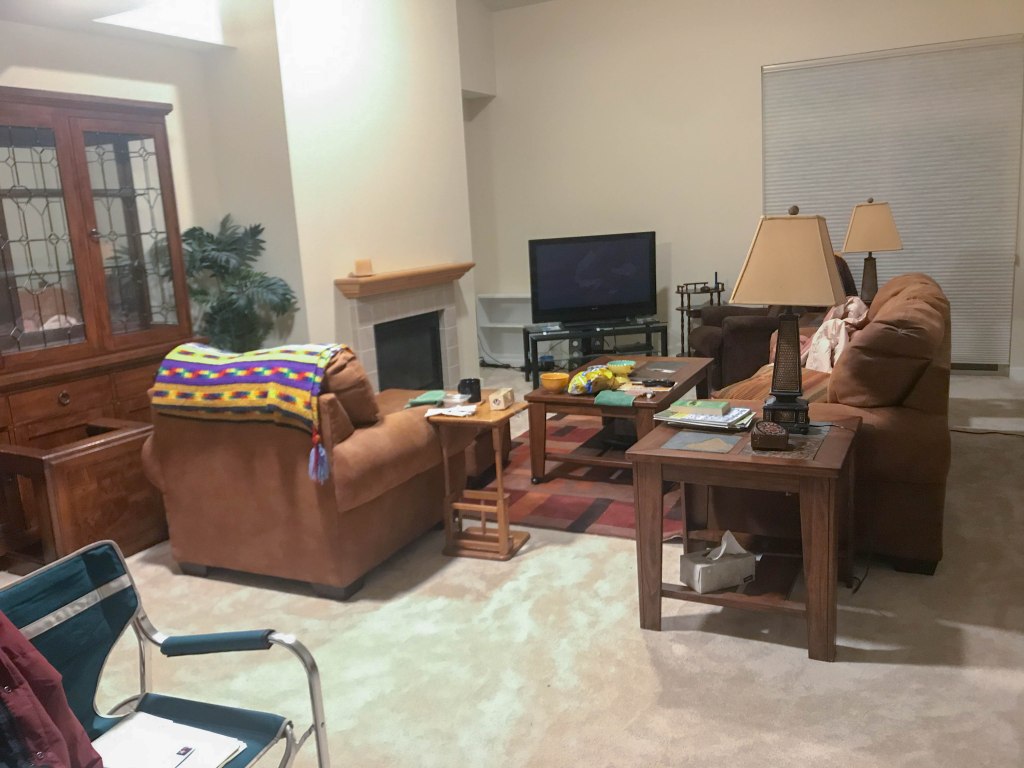
For us most of the furniture we got rid of we didn’t have an emotional tie to, and they went rather easily, mainly because they were purchased when we arrived here from Berkeley and hadn’t had time to make any attachments to us. There were some pieces from our family room we decided to keep to use as our living room furniture because we’d used them over the 14 years in Panorama Drive, and were comfortable with their use. Still, there wasn’t that sentimental emotional tone even with these.
Getting rid of stuff involves detaching from some things that carry a heavy load of sentiment – That’s why it’s so hard to give things up. In one downsizing issue at Panorama Drive I ended up painting over the pencil and pen markings on a section of the kitchen wall where since 2008 we had marked the heights of our four grandchildren in intervals of 6 months. So, for every year since Casey and Venice were 5 and Xander and Teiya were 2 we marked how tall they were, and in intervals of 6 months chronicled their growth spurts over time, until the elders were 18 and the youngers were 15 and we stopped taking their measurements. A lot of sentiment involved in painting over those markings, and cutting with it to paint over the tell-tale years, took some emotional strength, and now they are a memory trace lodged somewhere in the ethers of my mind.
Sorting through our photo albums from 1961 when we were married, was another deal, as in ordeal. So many of the photos were of events we have only memory traces of, and some of the people we no longer remember. Even still, there is a tug on the heart in tossing some of them out, saving only those with clear sentimental value to us.
Another bit of stuff that was hard was the library of books we have accumulated over the years – Me especially, gathered together a trove of history books covering all the wars the U.S. has fought, from the American Revolution, the Civil War, WWI, WWII, Korea, Vietnam, and some of Afghanistan and Iraq. A segment of the WWII selection included some 20 books covering the history and formation of the two Japanese American fighting units, the 442nd Regimental Combat Team and the 100th Infantry Battalion. Because my Uncle George fought in the 442nd, I have an emotional tie to that military unit. From Barbara’s side of the book stuff, her library was mostly fiction novels of her favorite authors, and she has a large number who are among that group. Between the two of us, we filled 14 shopping bags and a couple of cardboard boxes of books we gave to the Eugen Library – a library volunteer came with his pickup and hauled those books away. It was hard seeing them go, but eased by the knowledge that a goodly group of people are going to share in our reading history at some time in the near future, and that’s a good thing.
We brought from our home in Berkeley when we came to Eugene in 2007 a whole batch of boxes with the materials from my photography business. This included metal frames in jet black, silver, and brass (gold), all in varying sizes from 8”x10”, 11”x14”, and 16”x20”; mats for each of those sizes, glass for said same, and the hardware to put the frames together with the hanging wires in back. I also had volumes of color prints of images from my landscape photography work in sizes for each of the frames, photos of people from various of Barbara’s and my travels, and macro-photographs of flowers. I didn’t do much at all with promoting my landscape photographs since we arrived in Eugene, and all those materials sat in my closet for the 14 years we were in Panorama Drive. As part of our downsizing, my daughter-in-law Tori put me in touch with a local art supply business who caters to teachers and aids educators with various ways of supporting them, and I made a wholesale donation of all of my photography business materials for their use as they see fit. I used the general tax procedures for assessing the value of an art piece that is donated/contributed, that figure being the cost of the materials only, meaning the value could not be the value I might sell a photograph for (a 16”x20” framed photograph I used to sell for $175-180) – The material costs of frame, glass, print, hardware for a single print would come to around $20. The sum total of materials and photographs I donated to this local business came to around $4,000 in material value. I have a lot of sentimental attachment to most of the images I captured on film and later digitally, but it was with a very good feeling that I made this large donation to a business that caters to educators. I know it will all go towards good causes by those working to educate our children.
I said that downsizing is more a mental internal process, one of letting go, of detaching, of releasing the hold some things have on us over time. I love the sentiment that’s involved because they take us back to some remarkable and memorable events and peoples. I wouldn’t give those up for anything, but the stuff that they are aligned with, they are the material substance and not real in the realm of values. So, letting go, as hard as it is, gives us a different perspective on our future.
As someone once said, “Tally Ho…!”
Stay safe, my friends…


 Journeys of a Bent Mind