I ‘m going to tell you about this photograph, but first I’m going take a slight sidebar.

Learning the use of shutter speeds and aperture settings, the weight of highlights and shadows, or placing your primary subject composed aesthetically, are all well and good – they can often aid in the artistic use of camera and lens – but what must come before any of this is the passion for looking, the desire to see, the dance that allows you to enter into the realm of your subject, to be one with her, to unite with beauty. When one enters this world of the inner, nothing is the same, ever after. Which is truly who we are, if we would but find ourselves.
I have looked through the viewfinder of a camera since I was six years old coming back in February 1945 from three years in a prison camp in Southeastern Colorado for persons of Japanese ancestry. That was a mistake made by our government in a moment of hysteria and prejudice, but at the time it was what it was.
I had a number of plastic cameras growing up, basically elaborate pinhole cameras. They had a plastic lens, or a plastic covering over the pinhole, and a shutter. It wasn’t until I was in high school that I bought my first real camera, a German made Voigtlander folding camera. It had a real glass lens in place of plastic, and variable shutter speeds and aperture settings.
As an adult I progressed to more complex cameras, each level becoming more expensive. At one point with the support of my other half, I graduated to a professional level camera, a Nikon mid-level model. After a home burglary robbed me of several thousand dollars-worth of Nikon camera equipment, I and my insurance company switched to the replacement of it with Canon brand camera and accessories.
Up to this point I was learning my photography on my own, reading columnists in photography magazines, studying coffee table photography books, asking the question what was the photographer seeing when she or he took this shot?
Then, I took a weekend photography seminar, this one taught by a woman photographer and her husband partner. What I didn’t realize until much later, was that this was the beginning of the training of my eyes to see.
Barbara Brundege was a teacher’s teacher. She was this gentle powerhouse of energy you didn’t see so much as you felt. She shared much of what she knew about cameras and lenes, but you didn’t see it happening so much as you saw it in her work she shared liberally. She asked you to set up your camera, compose a shot, and asked to see it. She was more interested in what you were seeing in your viewfinder than telling you what to look for. Based on what you’d set up in your composition, she looked and asked what was it you were seeing? What caught your eye that you composed it that way? What spoke to you in that setting? What called your name? She didn’t ask this last question, but it’s what she meant.
This was all very subtle and effective. She didn’t suggest or impose what she saw in what you shared with her, she wanted to know what it was you were seeing. And that was it, that’s how it happened that I learned, rather that I experienced, that photography is all about seeing.
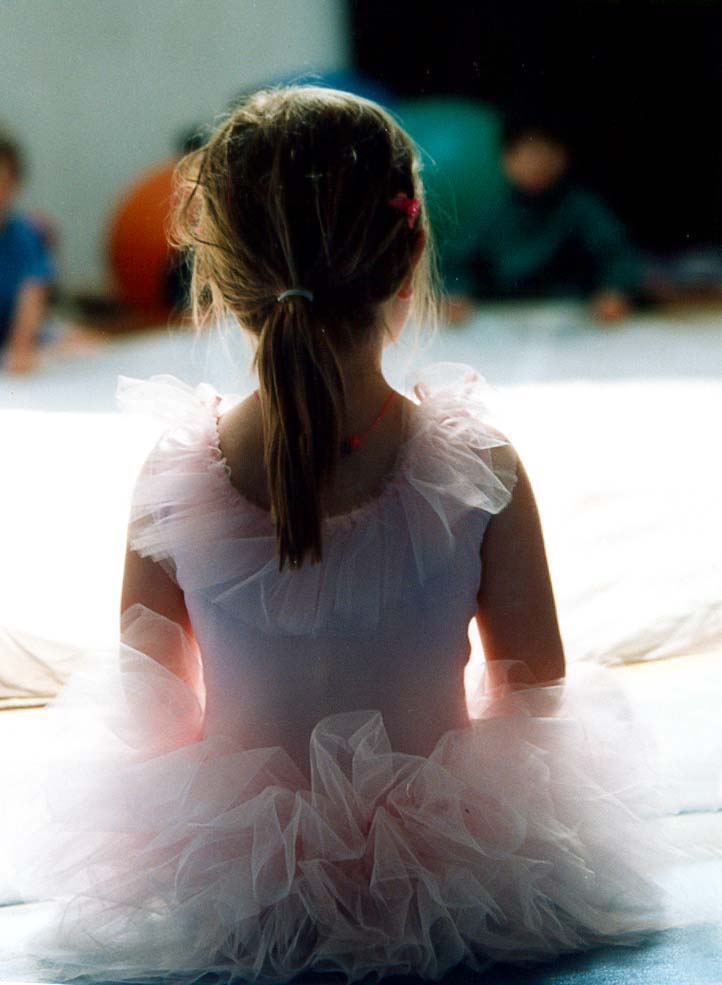
Now, about this photograph of a little ballerina – It is one of my favorites of all that I’ve taken of people.
A friend had invited us to a dance recital of her granddaughter’s dance studio in Albany, California. The recital was held in the gymnasium of the local YMCA. This young dancer isn’t the granddaughter, but her friend. During the performances she came out along the edge of the floor and sat down right in front of us. She was waiting her turn to go onstage.
I got out of my chair, slipped behind her cross-legged, and waited. I chose to use only the lighting in the gym, and cropped in close to fill the viewfinder frame. I waited only a few moments just so I could search quickly for the element that would make this “the” shot. And then, I clicked the shutter. It wasn’t until I received the developed slide back that I found what I had searched for and missed – In the photo I am sitting slightly to the girl’s right, not directly behind her. This slight edge gave me a view of her right cheek, which makes the shot…


 Journeys of a Bent Mind