I love photography. Anyone who knows me knows that about me. I started out as a complete novice, knowing only that if I pointed the box and pushed the switch I got some results. I had nothing to compare the results against, until I figured out there were professional photographers who did this for money. When I looked at their work I had nothing to measure it against, except to note that they were most of them pleasing to look at. I still had no measure to sort out why that was.
When I was in college I started reading columns by photographers in photography magazines, studying coffee table books by photographers, and discovered that some local photographers taught photography classes in local adult education programs. After taking several adult ed classes, I discovered an even richer field of learning in weekend photography workshops, and that began a rich period in the education of my photography skills.
Two early workshops come to mind: one focused on landscape photography, the second on general photography. For each we were asked to bring a slide to show and the instructor would critique and give us feedback. For the first, the instructor didn’t get past putting my slide up on the screen, when he dismissed it outright because it had a house in the background. His contention was that true landscapes didn’t have anything manmade in its scope. The second instructor judged my photo of a bougainvilla flower was improperly composed because I had placed the single flower in the upper left corner, and left some 80% of the rest as open space. The flower, my primary subject, was isolated and lost because of the expansive space.
Undaunted, I took the feedback for what it was, one person’s opinion. I learned an important thing about photographers, at least some of them – while some may be highly skilled in their art, may have an exceptional eye for composition and handling light and shadows, but their genius gets in the way of their being a serious and effective instructor. I balanced them against the woman instructor I soon discovered who opened my eyes as a photographer, and led me to my first experience of seeing.
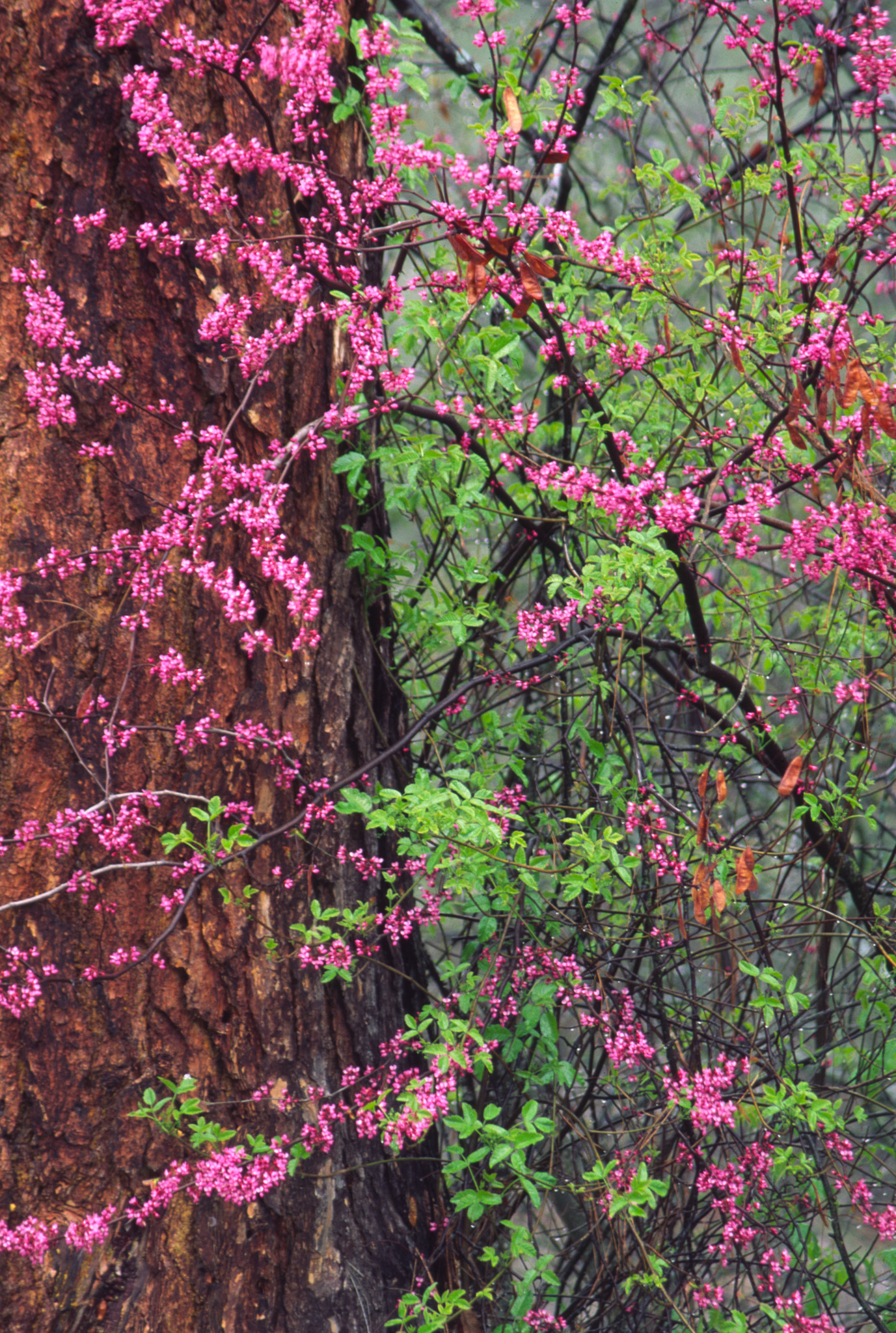
Barbara Brundage taught some 6-7 weekend workshops on various topics, and I eventually took them all. The first weekend stands out in my mind for how she conducted the session. It was held in the Sierra Nevada foothills east of Fresno, California, and focused on photographing buckeyes and redbuds. This was early in my marriage, and we asked if Barbara could come with me on the weekend. Instructor Barbara gave her consent provided my Barbara didn’t take part in any instructional parts of the sessions, and there would be no charge for her presence. During the sessions, Barbara stood off to the side as only an observer.
Instructor Barbara’s approach was to give us lectures about some aspect of photography, then she’d point out our subjects nearby and invite us to start shooting. As I set up my camera and tripod composing a shot, she asked if she could see what I was working on. She would look through my viewfinder, and instead of offering a suggestion on composition, asked what was I seeing that I composed the shot in the way I did? What caught my eye? What spoke to me? What called my name? Actually, she didn’t ask all those questions, and in the brief time I was asked what it was I saw, it never occurred to me what it was she was doing. She was helping me grasp what it was I was seeing. I wasn’t seeing the world through her eyes, but through my own and I was talking about it out loud. I somehow missed that this was happening.
In every workshop of hers I subsequently took, she worked the same way, always asking to see what we were composing, and what it was we were seeing. I found that in describing what I was doing, I gradually began to understand what it was I was seeing, why I composed in the fashion that I did – I was becoming very familiar with how I was seeing, how my eyes functioned.
This measure, this method of instruction, this way of sharing her love of photography with others, has been the way I teach my classes. Like Barbara Brundage, I make available everything I know about photography, everything about how I look and how I see, to any who ask. I consider it a gift I received from my favorite teacher, and I am most glad to share it all in the same fashion in which I received it.
Here’s the kicker – I hadn’t observed and figured out how Barbara Brundage worked with us to have us learn to see. My Barbara, who only stood in the background merely watching, it was her keen eye that discerned by watching her work, she figured it out and later informed me.


 Journeys of a Bent Mind