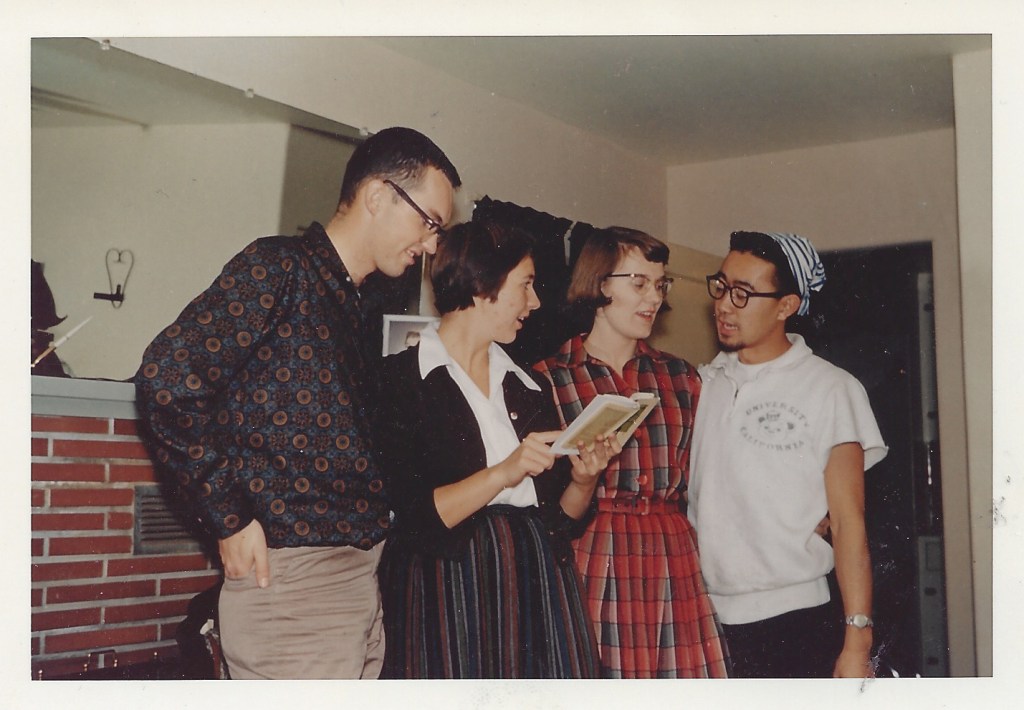
Wesley Foundation was a major part of my life in college starting in 1957. I met Barbara, my future wife there, though it would be several years before that ever developed. Barbara and I were on the leadership council at Wesley and worked together with the minister who led the center. There were planning sessions and leading the meetings of the other students, and this put us together a lot. Because we often met before our regular Sunday evening meetings, we started having dinner in Barbara’s and her roommate Lori’s apartment with Lori’s boyfriend Terry. In addition, we went out socially as a group, sort of group dating, but nothing formal in the way of couples.
In 1959 as seniors, unbeknownst to me Barbara and Lori began orchestrating things so that Barbara and I ended up together on our outings. All of this happened completely over my head, and I was clueless as to what was going on. I didn’t realize women did this sort of thing. It was at one of those pre-meeting dinners that we were all talking and joking around, and I said something I thought was cute, and Barbara tossed a half glass of water into my face and ran off laughing. I chased her into the bathroom and we tussled a bit, and I turned the handle on the sink and started dousing her with water.
Suddenly, we stopped, and Lori and Terry in the other room and Barbara knew that something had clearly shifted in our relationship. I was the only one in the dark and unclear about what had just happened. Barbara, on the other hand was quite clear and direct in her expressing her attraction to me. From that night on we were a couple, though I was still a little hazy on the depth of it all. Our little group continued to go out together, but now as couples.
Things for me were a mix of excitement in being in a dizzying relationship, alongside questions of dating a white girl. Mostly the latter was going on in the back of my mind, and much of it barely conscious. Mostly, I was a blathering idiot in feelings, but Barbara and I never talked about race.
When the winter semester came to the Christmas holidays in late December 1959, Lori invited Barbara and me and her boyfriend Terry to her home for a weekend before everyone left for home. Late one evening after everyone else had gone to bed, we were sitting on the floor holding hands in front of a large bay window overlooking the backyard, where everything was bathed in the light of a full moon. We talked long into the night, and everything was quiet and serene, and romantic. Time had stopped and we were in another dream world, another universe. At one point I heard myself asking out loud and out of the blue, “Will you marry me?” The silence that followed couldn’t have been more than a handful of seconds, but if felt like an eternity, and I froze. Did I really say that out loud? What was I thinking? Panic set in. Then, came the answer, “yes.”
The next morning, we told Lori and Terry about the evening, but didn’t share the news with Lori’s parents. We then left for our own separate homes for the holiday break. Except for me. For reasons I don’t recall, I had decided not to go home for the holidays but remained in Berkeley and awaited the New Year and beginning of classes again. It was a mistake and I regretted being all alone in a virtual ghost town. All the students were gone, but me.
Because this was such an important thing, I called Mom and Dad and explained what had happened, and that Barbara and I were now engaged. There was a pregnant pause on the other end of the line, and then, “I had hoped you’d marry a nice Japanese Girl…!” Things on the home front were a little tense after that. When Barbara told her mother about what happened, her response was similar: “I had hoped you would marry an American!” “Mother, he IS an American!” Things were a little tense here as well.
Barbara and I left things alone and avoided any talk with our parents about us. We essentially got lost in our own world in Berkeley and with our friends.
In February 1961 we were married at the little chapel at the First Methodist Church in Berkeley, the minister who led the Wesley Foundation officiating. Our parents were in attendance, and they were all on their best behavior as good parents should be. Whatever their true feelings, they were masked for the benefit of the bride and groom and our friends. It was a very nice celebration.
Then, four years later when Paul was born, becoming a grandparent turned things around for both Barbara’s mother and my parents. Paul wasn’t the first grandchild in my family, but he was the firstborn of the eldest son, and that was important in a Japanese family. My parents, especially Mama, had a dramatic change of heart and like good Japanese parents welcomed Barbara into the family.
Years later I learned something that blew my mind and cut me to the quick. Mama shared that when it became known Barbara and I were engaged, Reverend T, minister of the Livingston Methodist Church where I had attended while in high school, contacted them and implored them to convince me not to marry a white girl. How he had learned of our engagement to get involved in this way I never heard. At the same time Reverend H of the First Methodist Church in Berkeley where Barbara and I attended while at Cal, also contacted Mom and Dad and urged them to intervene and prevent the marriage from happening. Because Wesley Foundation had its program at the First Methodist Church in Berkeley, it was understandable how Reverend H leaned about our engagement. However, these two men had been important people in my life as mentors and teachers, so their stance was a serious blow to me and began the souring of my relationship with formal religion.
In a curiously related incident, Barbara’s brother David, classic younger brother he, gave this response to his sister on hearing of our engagement: “You finally did it…!” What he meant by that was his “goodie two-shoes” sister had finally rebelled against their mother, which he thought was so cool.


 Journeys of a Bent Mind