There were two episodes after we were married where race played a noticeable role. The first was soon after our marriage when we were looking for an apartment in Berkeley. I had gone out in response to an ad in the paper, and when the woman opened the door, she took one look at me, hesitated, and said that her husband had just rented the apartment. Okay, that happens. But on reporting back to Barbara, I said I thought the woman didn’t rent to me because I was Japanese. This was 1961 Berkeley. Barbara thought I was being overly sensitive and a little paranoid. A week later the ad for the apartment was still listed in the paper so we went out to check. This time a man answered the door, and upon seeing us, hesitated, and said his wife had just rented the apartment. Barbara became a believer.
The second episode came years later when we were in Boulder, Colorado for our daughter Diana’s graduation from the University of Colorado in 1993. To give perspective, I need to explain the setting for Barbara and me and our life in Berkeley. We chose to live in Berkeley after we were married because the city was well integrated with nearly 50% persons of color. There were, however, sections of the city where we wouldn’t have been able to buy a home. And then, drive just over the Berkeley hills into Contra Costa County, and you entered a lily-white enclave with low percentages of any other color. When we drove out of the San Francisco Bay Area we found this to be true of much of California as well. So, in our drive through the states between California and Colorado, stopping for meals was an experience with which we were all to familiar.
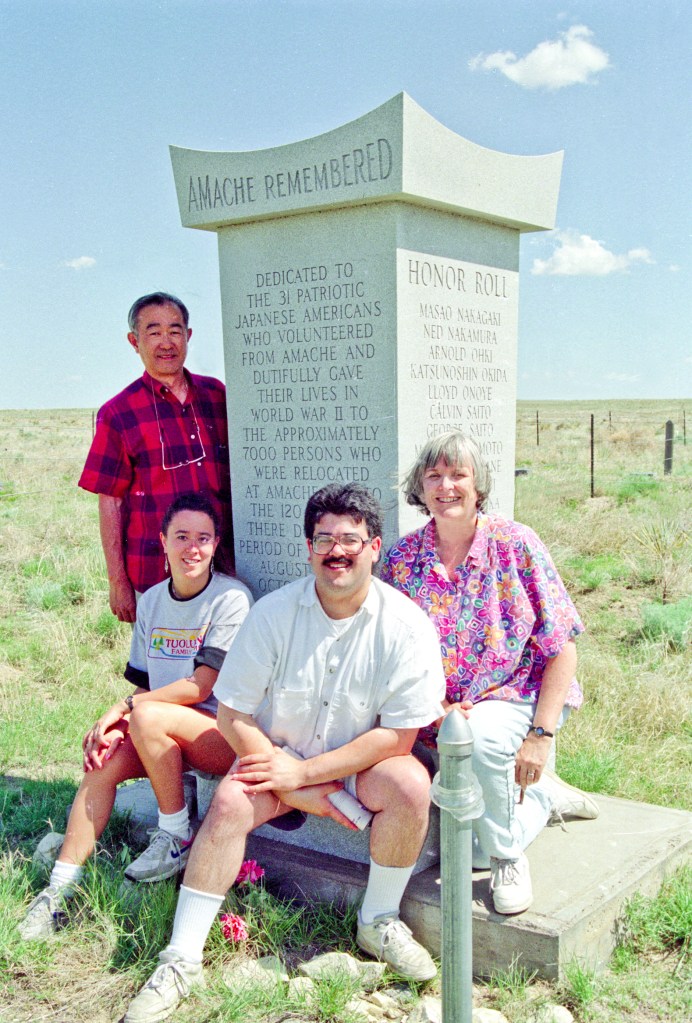
After Diana’s graduation ceremony we made a pilgrimage out to Camp Amache in the southeastern part of the state where my family had been imprisoned during WWII. We stopped for breakfast on the way at a café that turned out to be what I thought of as a redneck haven. In the parking lot there were many pickup trucks with whip antennas and gun racks in the back windows. When we entered the restaurant, the conversations stopped dead cold, and all eyes followed us as we were led to a table. Here we were this mixed-race couple, two clearly mixed-race kids, and a young girl with blazing red hair, our daughter’s best friend from childhood, who alone must have been a puzzlement as to how she fit into this unusual group. This was a most illuminating experience for both our son and daughter who had experienced very little in the way of racism in their lives living in Berkeley, and for our daughter’s best friend.
There were times when we could chuckle and smile over an incident if we didn’t think too seriously about it in the moment. One was with my mother. After the awkward and uneasy situation for our parents with our mixed-race marriage, as time passed after our wedding day Grandma Nagai enjoyed a benign sort of reverse racism whenever it surfaced that Barbara didn’t understand or know something of Japanese language or culture. It tickled her so to poke fun at this white girl trying to become a little Japanese. It was always in jest, and I think without malice. We both laughed along with her, and Mama ultimately grew to love Barbara as family and the teasing stopped.
At Osher Lifelong Learning Institute at the University of Oregon there were two incidents of what I think of as benign racism. One time during a discussion in International Relations the topic was around WWII, and during a break a woman came up to me and said something like, “Your people are exceptional because in spite of the tragedy of the internment no one caused any trouble!” The “your people” is what gave it away, and in the moment, I didn’t know what exactly to say.
The second incident involved the woman realtor we initially had for house hunting in 2007 when we first arrived in Eugene. She was an OLLI member and we thought it our fortune to have found her. The primary thing we didn’t want was a home with any kind of yard that would require us to do yard work. At our age we didn’t want that burden. Yet, she kept taking us to these homes with beautiful large yards that obviously were going to involve a lot of yard work, either done by us or hired. Her explanation when we tried to clarify things was that being Japanese, she thought I’d enjoy doing the gardening. At the time we chuckled over this, but what could we say?
One final thing about race and my personal history. In grammar school I was conscious of being different because I was Japanese. I thought the white kids were being given favored treatment by the teacher because they were white. There was some truth in this perception, but I was wrong in the reasoning why. What I didn’t realize was that in addition to being sensitive to being a minority, I was an introvert, and the white kids mostly were extroverts, and the reason the teacher noticed and called on them was that when she asked a question all their hands shot up and I held back. I didn’t know what an introvert was, or an extrovert, but I was mixing up the reasoning why I wasn’t being noticed, and it wasn’t because of race. There were a lot of things I thought the white kids did to get the attention and receive positive responses, and I tried to mimic what I thought I saw, thus hopefully making me more like the white kids and noticed. I thought I was trying to be like the white kids, or maybe an extrovert if I’d known what that was. It was all very confusing.
Even though I had not experienced any overt racial assaults in grade school, it wasn’t until I entered high school that I stopped avoiding my Japanese heritage and returned to my being Japanese. The most outwardly noticeable action was I started using my middle name again, Hideaki. I had stopped using it in grade school because it sounded too Japanese, and after the war that wasn’t something I wanted highlighted. I actually told my teachers I didn’t have a middle name. The fallacy of my childhood thinking was that eliminating my Japanese-sounding middle name didn’t change the fact that my family name was still so very Japanese, and I was still using it.


 Journeys of a Bent Mind